Last updated: 19 November 2026
SMG takes your farm or producer group from a GLOBALG.A.P. IFA v6 gap assessment to GLOBALG.A.P. certification. GLOBALG.A.P. is a farm assurance standard for good agricultural practices, owned by GLOBALG.A.P. c/o FoodPLUS GmbH. It shows buyers that crops, livestock or aquaculture products were produced safely, with care for workers, animals and the environment. The main standard is Integrated Farm Assurance (IFA) Version 6, issued in two editions: IFA v6 Smart and IFA v6 GFS. The GFS edition for fruit and vegetables is recognized by the Global Food Safety Initiative (GFSI). GLOBALG.A.P. suits fruit and vegetable growers, producer groups, flower and plant producers, and aquaculture and livestock farms that sell to retail or export buyers. SMG offers independent gap assessments against the IFA v6 control points, sample audits of producer group members and training, for growers in Lebanon, Saudi Arabia and the wider region.
Key facts
- Standard
- GLOBALG.A.P. Integrated Farm Assurance (IFA)
- Current edition
- IFA Version 6 (Smart and GFS editions)
- Published by
- GLOBALG.A.P. c/o FoodPLUS GmbH (scheme owner)
- Type
- Scheme: farm assurance standard for good agricultural practices
- Who it is for
- Fruit and vegetable growers, producer groups, flower and plant producers, aquaculture and livestock farms
- Certificate and audit cycle
- Gap assessment first, then the GLOBALG.A.P. inspection and certificate
- Transition or revision status
- IFA v6 Smart replaced v5.2 from 1 January 2024
- Related standards
- FSSC 22000, BRCGS, ISO 22005, GHP, organic production rules
- SMG service
- Gap assessment, producer group sample audits, GLOBALG.A.P. certification and training
- Where SMG works
- North America: Canada, USA and Mexico. Middle East: Saudi Arabia, the GCC (UAE, Qatar, Kuwait, Bahrain, Oman), Lebanon and Türkiye. Europe: UK, Ireland, Belgium, Italy, Spain, Portugal, Austria and Switzerland. Africa: Egypt, Morocco, Tunisia, Algeria, Libya, Nigeria, Ghana, Côte d'Ivoire, Liberia, Congo (Kinshasa and Brazzaville), Kenya and South Africa. Asia: China, Japan, South Korea, Indonesia, Malaysia and Vietnam.
- Audit languages
- English, Spanish, French, Arabic, Mandarin, Cantonese, German and Italian. In other countries SMG works with qualified local auditors.
What is GLOBALG.A.P.?
GLOBALG.A.P. is a farm assurance standard for good agricultural practices, owned by GLOBALG.A.P. c/o FoodPLUS GmbH. It shows buyers that crops, livestock or aquaculture products were produced safely, with care for workers, animals and the environment.
The main standard is Integrated Farm Assurance (IFA) Version 6, issued in two editions, IFA v6 Smart and IFA v6 GFS. The GFS edition for fruit and vegetables is recognized by the Global Food Safety Initiative (GFSI).
Who needs GLOBALG.A.P.?
You need GLOBALG.A.P. when a supermarket or export buyer lists it as a condition of supply for farm products. Typical users are:
- Fruit and vegetable growers that supply supermarkets or exporters.
- Producer groups and farmer cooperatives.
- Flower, plant and propagation material producers.
- Aquaculture and livestock farms.
The trigger is usually an export or retail buyer. Growers in Lebanon, Saudi Arabia and the wider region often need GLOBALG.A.P. to sell into European and GCC supermarket chains.
What are the benefits of GLOBALG.A.P.?
GLOBALG.A.P. opens retail and export buyers that require farm assurance, and its control points bring order to farm records and practices. The main benefits are:
- Access to retail and export buyers that list GLOBALG.A.P. as a supply condition.
- Clear rules on plant protection products, fertilizer, water and hygiene at harvest.
- Better worker safety and welfare practices.
- Records that support traceability and residue control.
- A recognized route for small farms through group certification.
How does GLOBALG.A.P. connect to other standards?
GLOBALG.A.P. covers the farm. Once produce leaves the farm, packhouses and processors often use FSSC 22000, BRCGS or ISO 22000. Good hygiene practices under Codex apply at harvest and handling, and ISO 22005 traceability links the farm to the next step in the chain.
How does GLOBALG.A.P. certification work with SMG?
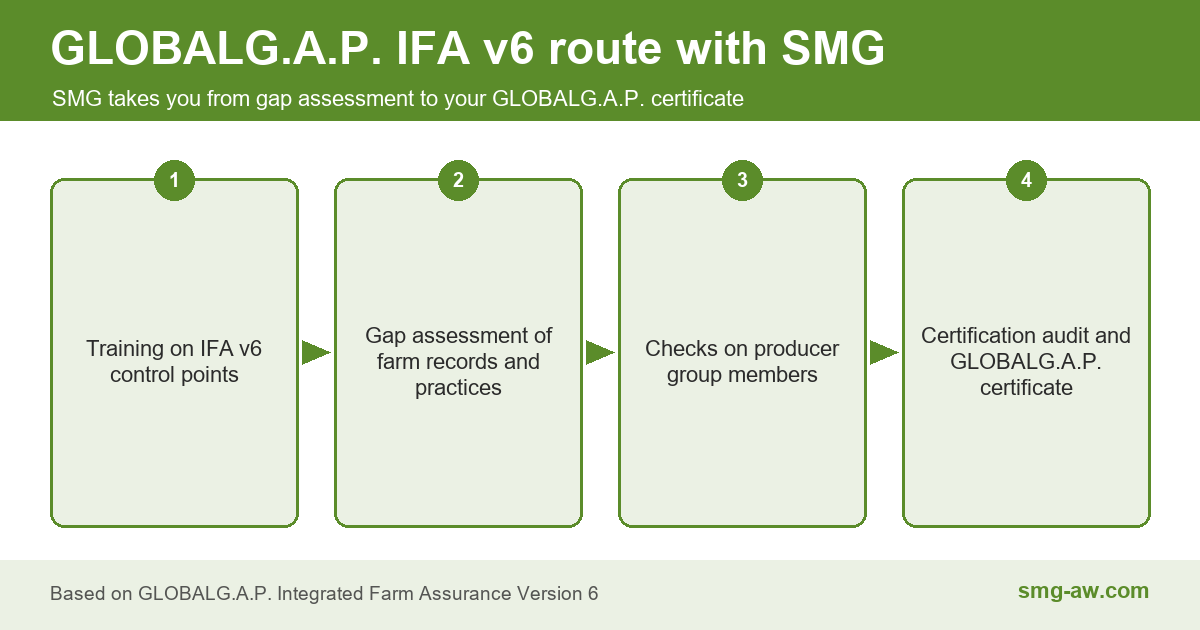
SMG takes your farm or producer group from a gap assessment against the IFA v6 control points to GLOBALG.A.P. certification. The route covers:
- Gap assessment: a pre-audit of your farm or producer group against the IFA v6 control points, with a clear list of gaps.
- Internal inspection support for producer groups: we audit a sample of member farms so you can test your internal system.
- Training: IFA v6 requirements for farm managers and internal inspectors.
- GLOBALG.A.P. certification: once your gaps are closed, your farm or group moves on to the GLOBALG.A.P. inspection and certificate.
For the packhouse and processing stages after the farm, ask about our ISO 22000 and FSSC 22000 certification.
IFA v6 Smart vs IFA v6 GFS
| IFA v6 Smart | IFA v6 GFS | |
|---|---|---|
| Core control points | Shared core | Shared core |
| GFSI recognition | No | Yes (fruit and vegetables) |
| Typical user | Growers whose buyers do not ask for GFSI | Growers whose retail buyers demand GFSI-recognized certification |
Frequently asked questions
Can SMG take my farm through to GLOBALG.A.P. certification?
Yes. SMG takes your farm or producer group from a gap assessment against the IFA v6 control points to GLOBALG.A.P. certification. We show you the gaps, audit a sample of member farms if you run a group, and train your team. Once the gaps are closed, you move on to the GLOBALG.A.P. inspection and certificate.
Which version of GLOBALG.A.P. applies?
Integrated Farm Assurance Version 6 is current for fruit and vegetables. IFA v6 Smart replaced Version 5.2 from 1 January 2024, and the IFA v6 GFS edition is the one recognized by GFSI. Check the GLOBALG.A.P. website for the current version of other scopes, such as livestock and aquaculture.
What is the difference between IFA v6 Smart and IFA v6 GFS?
Both editions share the same core control points. The GFS edition also meets the GFSI benchmarking requirements, which some retailers demand from their fresh produce suppliers. Ask your buyer which edition they accept before you book an inspection, so you prepare for the right one from the start.
Can a producer group get GLOBALG.A.P. certification?
Yes. GLOBALG.A.P. offers group certification for producer groups that run an internal management system and inspect their own members. A gap assessment tests that internal system, and a sample of member farms, before the certification inspection, so weak points are found while there is still time to fix them.
How much does a GLOBALG.A.P. gap assessment cost?
The cost depends on the number of farms or sites, the crops or products in scope, whether you are a producer group, and travel to your farms. A single farm needs much less time than a group with many members. SMG sends a written quote once you share your farm list, crops and locations.
Is GLOBALG.A.P. mandatory?
No law requires it. GLOBALG.A.P. is a voluntary scheme, but many European and GCC supermarket chains and exporters make it a condition of supply for fresh produce. If your buyer asks for it, you need a GLOBALG.A.P. certificate. Local food and pesticide laws still apply whether or not you are certified.
Related standards
- FSSC 22000: Food safety certification for packhouses and processors after the farm gate.
- BRCGS: Retailer-led standard for processing and storage of fresh produce.
- ISO 22005: Traceability from farm to customer.
- GHP: Codex hygiene practices at harvest and handling.
- Organic: Many growers combine farm assurance with organic production rules.