Last updated: 19 November 2026
GHP (Good Hygiene Practices) are the basic measures that keep food safe and suitable wherever it is prepared, stored, served or sold. They cover clean premises, safe water, pest control, staff hygiene, temperature control, allergen control and the safe handling of raw and cooked food. GHP is set out in Chapter One of the Codex General Principles of Food Hygiene, CXC 1-1969, last revised in 2022 by the Codex Alimentarius Commission of FAO and WHO. It applies to hotels, restaurants, caterers, central kitchens, food retailers and small producers that are not yet ready for HACCP or ISO 22000. GHP is a code of practice, not a certifiable standard, so there is no GHP certificate. You show that your business follows GHP through a compliance audit. SMG offers GHP compliance audits, audit programs for multi-outlet groups, gap assessments before inspections and food handler training in Saudi Arabia, the GCC, Lebanon and Canada.
Key facts
- Standard
- GHP (Good Hygiene Practices), Codex CXC 1-1969 Chapter One
- Current edition
- CXC 1-1969 General Principles of Food Hygiene, revised 2022
- Published by
- Codex Alimentarius Commission (FAO/WHO)
- Type
- Code of practice, not certifiable
- Who it is for
- Hotels, restaurants, caterers, central kitchens, food retailers, small producers
- Certificate and audit cycle
- No certificate: conformity shown by a compliance audit
- Transition or revision status
- Major revision in 2020, latest revision 2022
- SMG service
- GHP compliance audit, multi-outlet audit programs, gap assessment, training
- Where SMG works
- North America: Canada, USA and Mexico. Middle East: Saudi Arabia, the GCC (UAE, Qatar, Kuwait, Bahrain, Oman), Lebanon and Türkiye. Europe: UK, Ireland, Belgium, Italy, Spain, Portugal, Austria and Switzerland. Africa: Egypt, Morocco, Tunisia, Algeria, Libya, Nigeria, Ghana, Côte d'Ivoire, Liberia, Congo (Kinshasa and Brazzaville), Kenya and South Africa. Asia: China, Japan, South Korea, Indonesia, Malaysia and Vietnam.
- Audit languages
- English, Spanish, French, Arabic, Mandarin, Cantonese, German and Italian. In other countries SMG works with qualified local auditors.
What is GHP?
GHP (Good Hygiene Practices) are the basic measures that keep food safe and suitable wherever it is prepared, stored, served or sold. They cover clean premises, safe water, pest control, staff hygiene, temperature control and the safe handling of raw and cooked food.
GHP is set out in Chapter One of the Codex General Principles of Food Hygiene, CXC 1-1969, last revised in 2022 by the Codex Alimentarius Commission of FAO and WHO. It is a code of practice, not a certifiable standard. You show that your business follows GHP through a compliance audit, not a certificate.
Who needs a GHP audit?
Any business that prepares, stores, serves or sells food needs good hygiene practices, and an independent GHP audit is most useful for hotels, restaurants, caterers and retailers. Typical users are:
- Hotels, resorts and their kitchens.
- Restaurants, cafes and catering companies.
- Central kitchens and cloud kitchens.
- Supermarkets, bakeries and food retailers.
- Small producers that are not yet ready for HACCP or ISO 22000.
Hotel groups, franchise owners and food authorities in Saudi Arabia, the GCC, Lebanon and Canada often expect a regular, independent hygiene audit of each outlet.
What does a GHP audit cover?
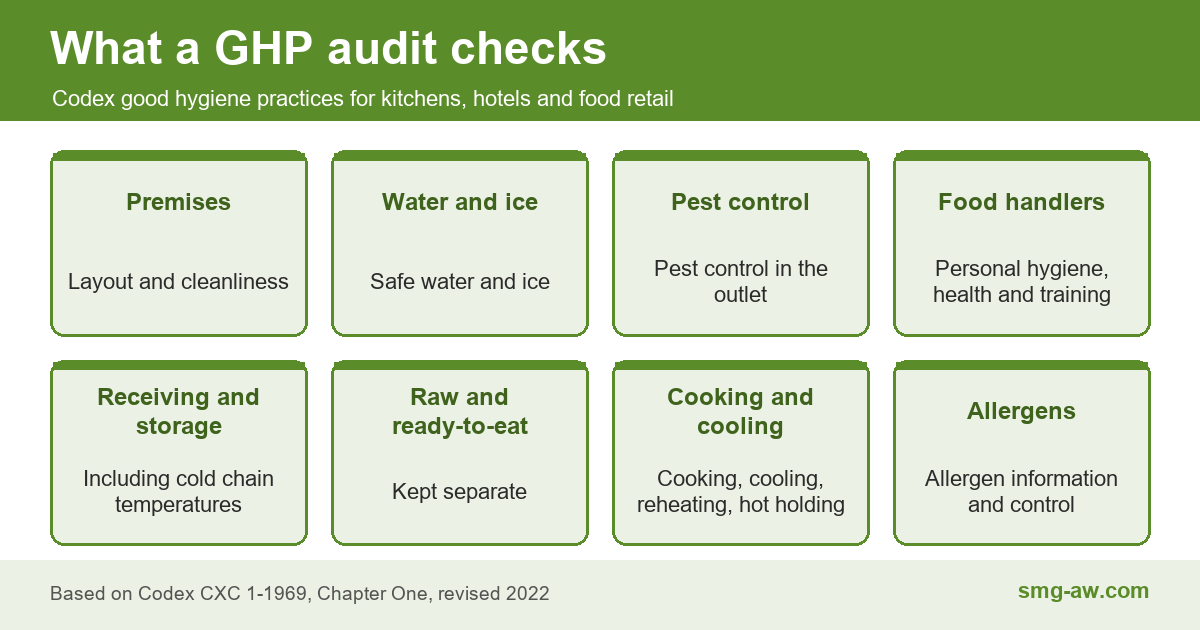
A GHP audit checks the daily hygiene of your outlet against Codex, from premises and water to cooking and cooling. It covers:
- Premises, layout and cleanliness.
- Safe water and ice.
- Pest control.
- Personal hygiene, health and training of food handlers.
- Receiving and storage, including cold chain temperatures.
- Separation of raw and ready-to-eat food.
- Cooking, cooling, reheating and hot holding.
- Allergen information and control.
- Cleaning schedules and chemical control.
- Waste handling and records.
What are the benefits of a GHP audit?
A GHP audit gives you an independent check of each outlet before guests, inspectors or brand auditors arrive. The main benefits are:
- Clear, ranked findings that managers can act on quickly.
- Consistent hygiene standards across a chain or franchise.
- Fewer surprises at authority inspections and brand audits.
- A base to build a HACCP plan on.
How does GHP connect to other standards?
GHP is the first chapter of the same Codex text that sets out HACCP, so the two work as a pair. GMP is the matching term for manufacturing. ISO 22002-2:2025 sets prerequisite programs for catering, and ISO 22000 sets a full food safety management system that can be certified.
How can you show conformity to GHP?
You show conformity to GHP through a compliance audit against Codex CXC 1-1969 Chapter One, not a certificate. SMG audits each outlet and gives you a written report with corrective actions.
SMG offers:
- GHP compliance audit: an on-site audit against Codex CXC 1-1969 Chapter One with a written report and a list of corrective actions.
- Multi-site audit programs for hotel and restaurant groups.
- Gap assessment before an authority inspection or brand audit.
- Training for food handlers and supervisors.
If you need a certificate, ISO 22000 covers catering and can be certified.
GHP vs HACCP
| GHP | HACCP | |
|---|---|---|
| Codex chapter | Chapter One of CXC 1-1969 | Chapter Two of CXC 1-1969 |
| Focus | General hygiene across the whole operation | Specific hazards at critical control points |
| Typical users | Food service, retail and the whole chain | Any food business with a defined process |
| Certificate | No, compliance audit | No, compliance audit |
Frequently asked questions
Can I get GHP certification?
GHP is a Codex code of practice, not a certifiable standard, so there is no GHP certificate. SMG audits your outlet against Codex CXC 1-1969 Chapter One and gives you a written report with findings and corrective actions. If you need a certificate, ISO 22000 is the usual route for caterers, hotels and food service groups.
What is the difference between GHP and HACCP?
GHP covers general hygiene across the whole operation, such as cleaning, pest control, staff hygiene and temperature control. HACCP focuses on specific hazards at critical control points in your process. Codex treats GHP as the base that HACCP builds on, and both sit in the same Codex text, CXC 1-1969.
How often should a restaurant or hotel kitchen be audited?
Codex does not set a frequency. Many hotel and restaurant groups audit each outlet once or twice a year, and more often after a complaint, a poor result or a change of kitchen team. Your brand standards or local authority may set their own frequency, so check those first and plan audits to match.
Is GHP the same as GMP?
They overlap. GHP is the Codex term used across the food chain, especially in food service and retail. GMP is the term most used in food manufacturing. Both rest on the Codex General Principles of Food Hygiene, so the checklists are similar, but a GHP audit focuses on kitchens, service and retail areas.
How much does a GHP audit cost?
The cost depends on the number of outlets, their size, opening hours and travel. A single restaurant needs much less time than a hotel with several kitchens. Groups with many outlets usually save by booking a planned audit program. SMG sends a written quote once you share your outlet list and locations.
Does a GHP audit replace an authority inspection?
No. Food authorities carry out their own inspections under local law, and an independent audit does not replace them. A GHP audit by SMG shows you where you stand before the inspector visits, so you can fix gaps first. Many hotel groups and franchise owners also use the report as evidence against their brand standards.
Related standards
- HACCP (Codex CXC 1-1969): Chapter Two of the same Codex text, built on GHP.
- GMP: Matching good practices for food manufacturing.
- ISO 22002 series prerequisite programs: ISO 22002-2:2025 sets PRPs for catering.
- ISO 22000: Certifiable food safety management system for caterers and hotels.
- Halal: Halal audits often run alongside hygiene audits in GCC food service.