Last updated: 19 November 2026
SMG takes you from an organic gap assessment to organic certification for Canada, the EU and the USA. Organic compliance means meeting a market’s organic production rules before food can be sold as organic. In Canada these are the Canadian Organic Standards CAN/CGSB-32.310-2026 and CAN/CGSB-32.311-2026 under the Safe Food for Canadians Regulations, published in March 2026 with one year for operators to comply. The European Union applies Regulation (EU) 2018/848, and the United States applies the USDA National Organic Program, 7 CFR Part 205. The rules limit synthetic inputs and require separation, records and traceability. Each regime is overseen by the CFIA in Canada, EU authorities and the USDA. The rules matter to growers, processors, exporters, importers and brand owners in organic supply chains. SMG carries out organic gap assessments, compliance audits against the rules of your target market, second-party supplier audits and training, so you are ready for your organic certification inspection.
Key facts
- Standard
- Organic production rules for Canada, the EU and the US
- Current edition
- CAN/CGSB-32.310-2026 and 32.311-2026, Regulation (EU) 2018/848, 7 CFR Part 205 (USDA NOP)
- Type
- National standards and regulations
- Who it is for
- Growers, processors, exporters, importers and brand owners in organic supply chains
- Certificate and audit cycle
- Compliance audit first, then the organic inspection and certificate under your target regime
- Transition or revision status
- Canadian Organic Standards 2026 published March 2026, with one year to comply
- Related standards
- ISO 22000, FSSC 22000, ISO 22005, GLOBALG.A.P., Codex HACCP
- SMG service
- Gap assessment, compliance audit, organic certification, supplier audits and training
- Where SMG works
- North America: Canada, USA and Mexico. Middle East: Saudi Arabia, the GCC (UAE, Qatar, Kuwait, Bahrain, Oman), Lebanon and Türkiye. Europe: UK, Ireland, Belgium, Italy, Spain, Portugal, Austria and Switzerland. Africa: Egypt, Morocco, Tunisia, Algeria, Libya, Nigeria, Ghana, Côte d'Ivoire, Liberia, Congo (Kinshasa and Brazzaville), Kenya and South Africa. Asia: China, Japan, South Korea, Indonesia, Malaysia and Vietnam.
- Audit languages
- English, Spanish, French, Arabic, Mandarin, Cantonese, German and Italian. In other countries SMG works with qualified local auditors.
What are the organic rules for Canada, the EU and the US?
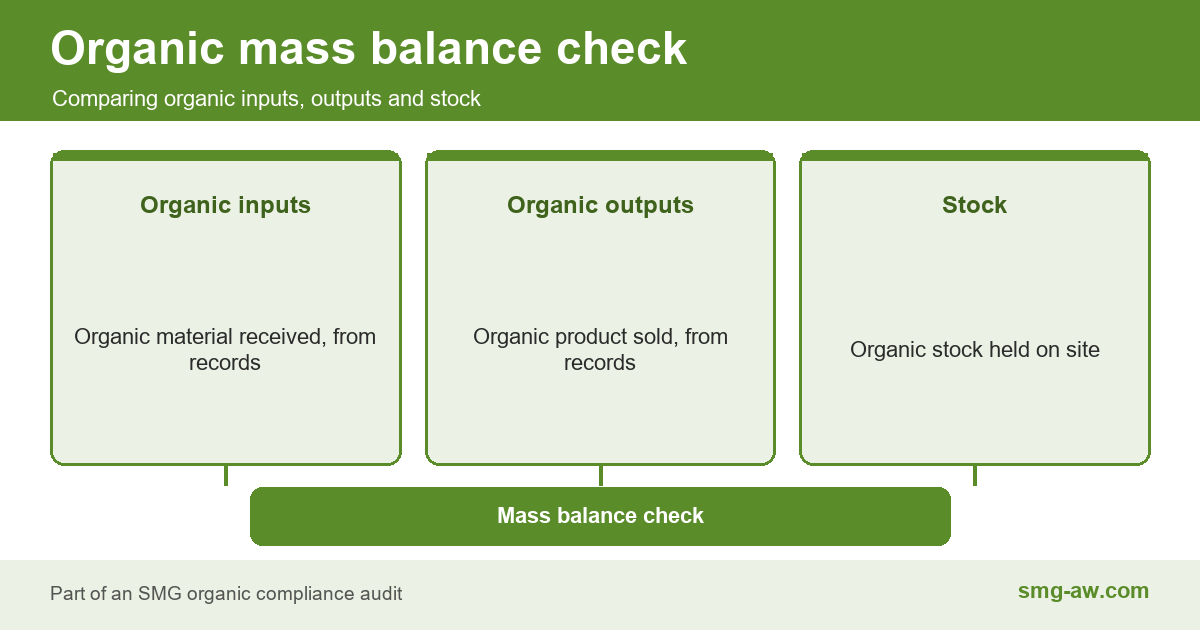
Organic rules set how food must be grown, processed and labeled before it can be sold as organic. They limit synthetic inputs, ban genetically engineered organisms and require separation, records and traceability. Each market sets its own rules.
- Canada: the Canadian Organic Standards, CAN/CGSB-32.310 (general principles and management standards) and CAN/CGSB-32.311 (permitted substances lists), under the Safe Food for Canadians Regulations. The 2026 editions were published in March 2026, with one year for operators to comply.
- European Union: Regulation (EU) 2018/848 on organic production and labeling, applied since 1 January 2022.
- United States: the USDA National Organic Program, 7 CFR Part 205, including the Strengthening Organic Enforcement rule in force since 19 March 2024.
These are regulations and national standards. You show compliance through an audit, and you sell as organic only with an organic certificate.
Who needs an organic gap assessment or compliance audit?
You need one if you plan to sell or buy organic products in Canada, the EU or the US and want to find gaps before your organic certification inspection. Typical users are:
- Growers and processors entering organic markets
- Exporters from Lebanon, Saudi Arabia and the GCC
- Importers, traders and brand owners buying organic ingredients
- Certified operators moving to the 2026 Canadian Organic Standards
What are the benefits of an organic compliance audit?
An audit shows your gaps before the certification inspection, so the inspection is more predictable.
- A clear list of gaps against your target market’s rules
- Better separation of organic and non-organic products on shared sites
- Input approval checked against the permitted substances lists
- Records that stand up to a mass balance check
How does organic certification work with SMG?
SMG takes you from an organic gap assessment to organic certification under the rules of the market you name. The usual sequence is:
- Scoping: we agree the target regime, products, sites and suppliers in scope.
- Gap assessment: we review your organic plan, input lists, supplier certificates and labels.
- Compliance audit: on site, we check separation, cleaning, storage, labeling and records, and run a mass balance and traceability exercise.
- Audit report: findings by requirement, graded by risk, with the evidence we saw.
- Organic certification: once your findings are closed, your operation moves on to the organic inspection and certificate under your target regime.
SMG also offers:
- Supplier audits: second-party audits of your organic suppliers’ separation, records and inputs.
- Training: organic requirements for production, purchasing and quality teams.
How do organic rules connect to food safety standards?
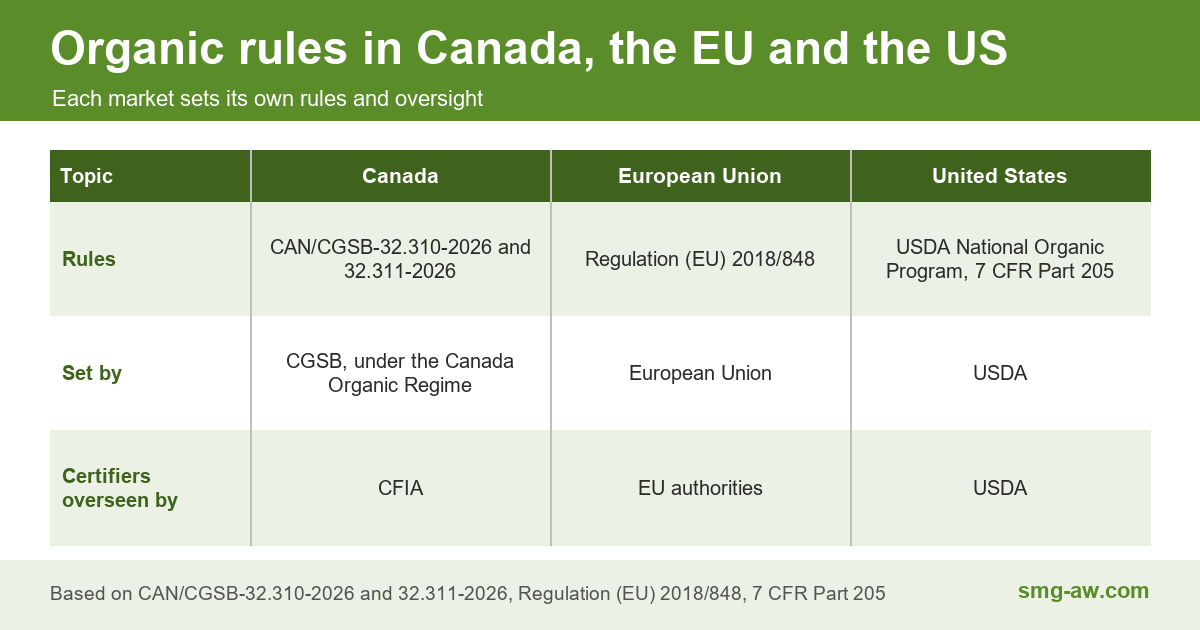
Organic rules sit alongside food safety rules, not in place of them. Organic processors still need HACCP, often through ISO 22000 or FSSC 22000. ISO 22005 traceability supports mass balance checks, and farms often add GLOBALG.A.P.
Organic rules in Canada, the EU and the US
| Point | Canada | European Union | United States |
|---|---|---|---|
| Rules | CAN/CGSB-32.310 and 32.311 (2026) under the SFCR | Regulation (EU) 2018/848 | USDA National Organic Program, 7 CFR Part 205 |
| Authority | Canadian Food Inspection Agency (CFIA) | EU and member state authorities | USDA Agricultural Marketing Service |
| Route with SMG | Gap assessment, compliance audit, organic certification, training | Gap assessment, compliance audit, organic certification, training | Gap assessment, compliance audit, organic certification, training |
Frequently asked questions
Can SMG take my products through to organic certification?
Yes. SMG takes you from an organic gap assessment to organic certification under the Canada Organic Regime, the EU organic regulation or the USDA National Organic Program. We carry out gap assessments, compliance audits, second-party supplier audits and training, so you are ready for your organic certification inspection.
What changed in the Canadian Organic Standards in 2026?
New editions of CAN/CGSB-32.310 and CAN/CGSB-32.311 were published in March 2026, replacing the 2020 editions. Operators have one year from publication to comply. Review the changes to the production rules and the permitted substances lists with your certifier, and plan a gap assessment before your next inspection.
Is organic certification mandatory?
It is mandatory if you want to use the word organic or an organic logo in markets that regulate it. In Canada, products sold as organic across provincial or national borders must be certified under the Canada Organic Regime. The EU and the US have similar rules. Selling without an organic claim needs no organic certificate.
Is a Canadian organic product accepted in the EU or the US?
Canada has organic equivalency arrangements with several countries, including the US and the EU. The terms and limits differ by arrangement, and some products or inputs may be excluded. Confirm the current arrangement and any extra conditions with the Canadian Food Inspection Agency and your certifier before you ship.
How long does an organic gap assessment take and what does the cost depend on?
Both depend on your operation type, the number of sites, products and suppliers, whether you handle organic and non-organic products together, the number of regimes you target and travel. A single processor needs less time than a grower with many fields or a multi-site group. SMG sends a written quote once you share these details.
Does organic replace food safety certification?
No. Organic rules cover how food is produced, such as inputs, separation and records. Food safety still needs its own controls, such as HACCP, ISO 22000 or FSSC 22000. Many organic processors hold both, and an organic compliance audit can be planned alongside a food safety audit to save time on site.
Related pages
- ISO 22000 certification: food safety management system that organic processors still need
- FSSC 22000 certification: food safety scheme many organic processors hold alongside organic
- ISO 22005 traceability: traceability and mass balance that organic inspections check
- GLOBALG.A.P.: farm assurance often held alongside organic production
- HACCP: hazard control that organic rules do not replace