Last updated: 19 November 2026
ISO 22000 is the international standard that sets the requirements for a food safety management system. The current edition is ISO 22000:2018 with Amendment 1:2024, published by ISO, the International Organization for Standardization. The amendment adds climate change wording to clauses 4.1 and 4.2. The standard joins the Codex HACCP principles with prerequisite programs and the same structure used by ISO 9001 and ISO 14001. It suits any organization in the food chain, including food and feed manufacturers, caterers, retailers, traders, transport and storage firms and food packaging makers. ISO 22000 is certifiable. A certificate runs for three years, with annual surveillance audits and a recertification audit in year three. SMG certifies ISO 22000 for food and feed processing, catering, retail and trading, transport and storage, and food packaging production, for clients in Canada, Saudi Arabia, Lebanon and the GCC. SMG also trains internal auditors and food safety teams.
Key facts
- Standard
- ISO 22000, Food safety management systems
- Current edition
- ISO 22000:2018 + Amd 1:2024
- Type
- Certifiable management system standard
- Who it is for
- Any organization in the food chain: food and feed processing, catering, retail and trading, transport and storage, food packaging
- Certificate and audit cycle
- 3-year certificate: Stage 1, Stage 2, decision, annual surveillance, recertification in year 3
- Transition or revision status
- Revision under way. The 2018 edition with Amd 1:2024 stays current until a new edition is published.
- Related standards
- FSSC 22000, ISO 22002 series, Codex HACCP (CXC 1-1969), ISO 22005, ISO 9001
- SMG service
- Certification (food chain categories C, D, E, F, G and I) and training.
- Where SMG works
- North America: Canada, USA and Mexico. Middle East: Saudi Arabia, the GCC (UAE, Qatar, Kuwait, Bahrain, Oman), Lebanon and Türkiye. Europe: UK, Ireland, Belgium, Italy, Spain, Portugal, Austria and Switzerland. Africa: Egypt, Morocco, Tunisia, Algeria, Libya, Nigeria, Ghana, Côte d'Ivoire, Liberia, Congo (Kinshasa and Brazzaville), Kenya and South Africa. Asia: China, Japan, South Korea, Indonesia, Malaysia and Vietnam.
- Audit languages
- English, Spanish, French, Arabic, Mandarin, Cantonese, German and Italian. In other countries SMG works with qualified local auditors.
What is ISO 22000?
ISO 22000 is the international standard that sets the requirements for a food safety management system. It helps any organization in the food chain control food safety hazards and show that the food it handles is safe to eat.
The current edition is ISO 22000:2018, published by ISO, with Amendment 1:2024 adding climate wording to clauses 4.1 and 4.2. It is certifiable. It joins the Codex HACCP principles with prerequisite programs and the same structure as ISO 9001. A revision is under way, and the 2018 edition stays in use until a new edition is published.
Who needs ISO 22000 certification?
Any organization that makes, handles, stores or moves food, feed or food packaging can seek ISO 22000 certification. Most do so because a retailer, export buyer, regulator or tender asks for independent proof that food safety is managed.
Typical users include:
- food, drink and animal feed manufacturers
- caterers, hotels and food service operators
- retailers, wholesalers and food traders
- transport, cold-store and packaging companies
Many organizations in Canada, Saudi Arabia, Lebanon and the GCC also use ISO 22000 as a first step towards FSSC 22000.
What are the benefits of ISO 22000?
ISO 22000 gives you one documented system to control food safety hazards, and a certificate gives buyers independent evidence that the system works. The main benefits are:
- A clear, documented way to identify and control biological, chemical and physical hazards.
- Evidence for customers, retailers and regulators that food safety is managed, not left to chance.
- One framework for HACCP, prerequisite programs and legal requirements.
- Easy integration with ISO 9001, ISO 14001 and ISO 45001, because the clause structure is the same.
- A strong base if you later move to FSSC 22000.
How does ISO 22000 connect to other standards?
ISO 22000 sits at the center of a family of food safety documents. It sets the management system, while other standards supply the hygiene basics, the hazard method and the scheme rules.
The ISO 22002 series sets the prerequisite programs for each sector. Codex HACCP (CXC 1-1969) supplies the hazard analysis method. FSSC 22000 builds on ISO 22000 to create a GFSI-recognized scheme. ISO 22005 covers traceability, and ISO 20001:2026 addresses food loss and waste with the same structure.
How does ISO 22000 certification work with SMG?
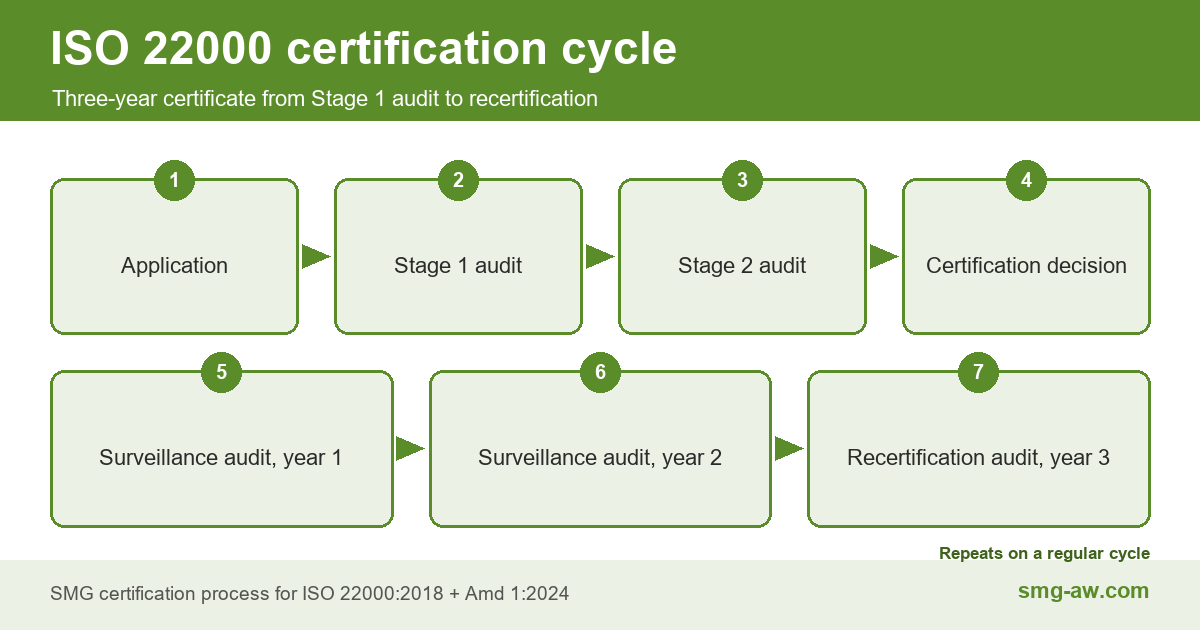
SMG certifies ISO 22000 for food and feed processing, animal feed, catering, retail and trading, transport and storage, and food packaging production (categories C, D, E, F, G and I). We serve clients in Canada, Saudi Arabia, Lebanon and the GCC, with a local office in Riyadh.
The certification cycle runs as follows:
- Application: you share your sites and processes, and we quote using the audit-time rules of ISO 22003-1.
- Stage 1 audit: we review your documented system, HACCP plans and readiness.
- Stage 2 audit: we check on site that the system works.
- Certification decision: a reviewer who was not on the audit team decides.
- Surveillance audits: once a year in years 1 and 2.
- Recertification audit: in year 3, before the certificate expires.
We also run ISO 22000 training for internal auditors and food safety teams.
ISO 22000 vs FSSC 22000 vs BRCGS Food Safety
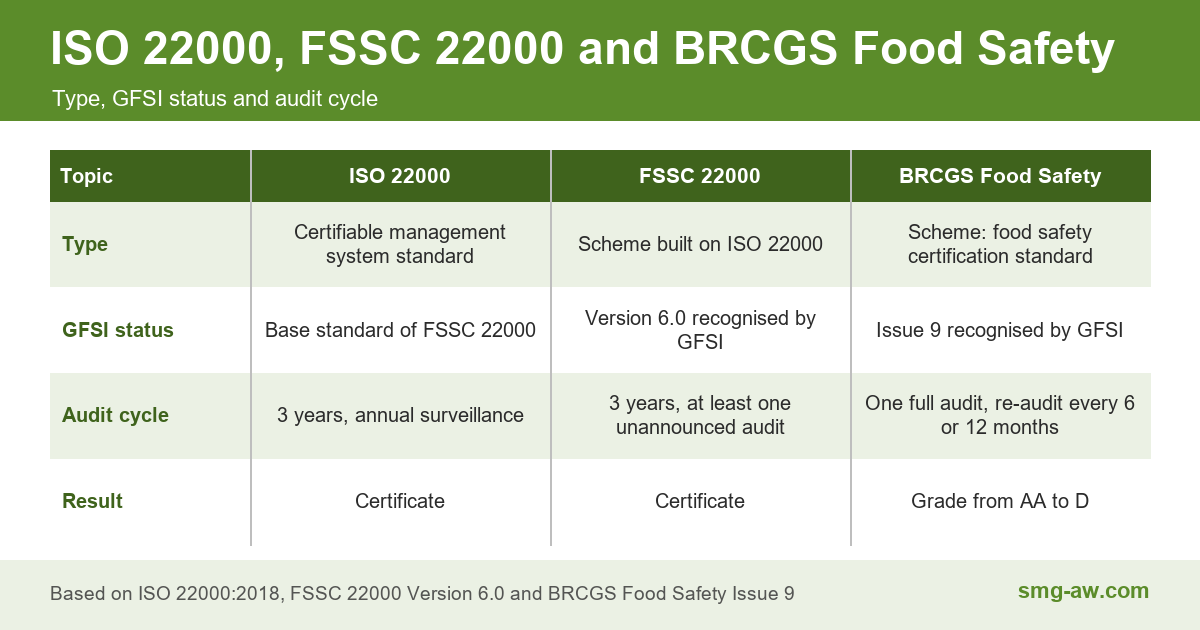
| ISO 22000 | FSSC 22000 | BRCGS Food Safety | |
|---|---|---|---|
| Type | ISO management system standard | Scheme built on ISO 22000 | Prescriptive BRCGS standard |
| GFSI recognized | No | Yes (Version 6) | Yes (Issue 9) |
| Prerequisite programs | You set them (clause 8.2) | ISO 22002 sector part required | Written into the Standard |
| Result | Certificate | Certificate | Certificate with a grade from AA to D |
| Audit cycle | 3 years, annual surveillance | 3 years, at least one unannounced audit per cycle | Re-audit every 6 or 12 months |
| Issued in the SMG group by | SMG | SMG | SMG Food Safety Solutions (SMGFSS) |
Frequently asked questions
What is the difference between ISO 22000 and HACCP?
HACCP is a hazard control method set out by Codex in CXC 1-1969. ISO 22000:2018 includes the HACCP principles and adds a full management system around them, with leadership, objectives, internal audit, management review and continual improvement. A working HACCP plan is a core part of every ISO 22000 system, but ISO 22000 also covers how the whole organization manages food safety.
What is the difference between ISO 22000 and FSSC 22000?
FSSC 22000 uses ISO 22000 as its core and adds a sector prerequisite program from the ISO 22002 series plus extra scheme requirements, such as food fraud and food defense. FSSC 22000 is recognized by the Global Food Safety Initiative (GFSI), while ISO 22000 on its own is not. Choose FSSC 22000 if your buyers ask for a GFSI-recognized certificate.
How long does ISO 22000 certification take?
Most organizations need several months to run their system and build records before the Stage 1 audit. The audits themselves take a few days, depending on your size, sites and number of HACCP plans. The certification decision follows once any major nonconformities are closed. The certificate then runs for three years, with surveillance audits in years one and two.
How much does ISO 22000 certification cost?
The cost depends on the audit time, which ISO 22003-1 sets from your number of employees, HACCP studies, sites and food chain category. Travel and the number of shifts also matter. SMG sends a written quote after you share these details, covering Stage 1, Stage 2, surveillance and recertification, so you see the full three-year cost before you start.
Is ISO 22000 certification mandatory?
No. ISO 22000 is a voluntary standard, and no law requires the certificate itself. Food laws in Canada, Saudi Arabia and the GCC do require hazard-based food safety controls, and many buyers and tenders ask for ISO 22000 or a GFSI scheme as proof. In practice, certification is often a condition of supply rather than a legal duty.
Is ISO 22000 being revised?
Yes. ISO is revising ISO 22000, and a draft went to ballot in 2026. Until the new edition is published, ISO 22000:2018 with Amendment 1:2024 is the edition you are certified against. When the new edition arrives, SMG will publish the transition dates and steps for its clients.
Related standards
- FSSC 22000: GFSI-recognized scheme built on ISO 22000 for clients who need retailer acceptance.
- HACCP (Codex CXC 1-1969): The hazard analysis method that ISO 22000 clause 8.5 builds on.
- ISO 22002 series prerequisite programs: Sector PRP requirements that support ISO 22000 clause 8.2.
- ISO 22005: Traceability design that supports ISO 22000 clause 8.3.
- ISO 20001:2026: Food loss and waste management system with the same structure, for integrated systems.
- ISO 9001: Quality management system that integrates easily with ISO 22000.