Last updated: 19 November 2026
HACCP (Hazard Analysis and Critical Control Point) is a method for finding the food safety hazards in your process and controlling them at the points that matter most. It is set out by the Codex Alimentarius Commission of FAO and WHO in Chapter Two of the General Principles of Food Hygiene, CXC 1-1969, last revised in 2022. The method has five preliminary steps and seven principles, from hazard analysis and critical control points to monitoring, corrective action, verification and records. HACCP applies to any business that makes, handles, stores, serves or sells food, and most food laws and certification schemes build on it. Codex texts are a code of practice, not a certifiable standard, so there is no HACCP certificate under Codex. You show that your HACCP system meets the Codex principles through a compliance audit. SMG offers HACCP compliance audits, gap assessments, second-party supplier audits and HACCP training for food businesses in Canada, Saudi Arabia, Lebanon and the GCC.
Key facts
- Standard
- HACCP, Codex CXC 1-1969 Chapter Two
- Current edition
- CXC 1-1969 General Principles of Food Hygiene, revised 2022
- Published by
- Codex Alimentarius Commission (FAO/WHO)
- Type
- Code of practice, not certifiable
- Who it is for
- Any business that makes, handles, stores, serves or sells food
- Certificate and audit cycle
- No certificate: conformity shown by a compliance audit
- Transition or revision status
- Major revision in 2020, latest revision 2022
- Related standards
- GHP (Chapter One), GMP, ISO 22000, FSSC 22000, ISO 22002 series, FSMA
- SMG service
- HACCP compliance audit, gap assessment, second-party audits, training
- Where SMG works
- North America: Canada, USA and Mexico. Middle East: Saudi Arabia, the GCC (UAE, Qatar, Kuwait, Bahrain, Oman), Lebanon and Türkiye. Europe: UK, Ireland, Belgium, Italy, Spain, Portugal, Austria and Switzerland. Africa: Egypt, Morocco, Tunisia, Algeria, Libya, Nigeria, Ghana, Côte d'Ivoire, Liberia, Congo (Kinshasa and Brazzaville), Kenya and South Africa. Asia: China, Japan, South Korea, Indonesia, Malaysia and Vietnam.
- Audit languages
- English, Spanish, French, Arabic, Mandarin, Cantonese, German and Italian. In other countries SMG works with qualified local auditors.
What is HACCP?
HACCP (Hazard Analysis and Critical Control Point) is a method for finding the food safety hazards in your process and controlling them at the points that matter most. It is the base of almost every food safety law and certification scheme in the world.
HACCP is set out by the Codex Alimentarius Commission of FAO and WHO in the General Principles of Food Hygiene, CXC 1-1969, last revised in 2022. Codex texts are a code of practice, not a certifiable standard. You show that your HACCP system meets the Codex principles through a compliance audit, not a certificate.
Who needs HACCP?
HACCP applies to any business that grows, makes, handles, stores, serves or sells food. That includes manufacturers, caterers, hotels, restaurants, retailers and distributors.
Many food laws expect a HACCP-based approach. In Canada, the Safe Food for Canadians Regulations require many license holders to keep a preventive control plan. In Saudi Arabia and the GCC, food authorities and buyers often ask for evidence of a HACCP system. Customers also ask for an independent HACCP audit before approving a new supplier.
What are the 7 HACCP principles?
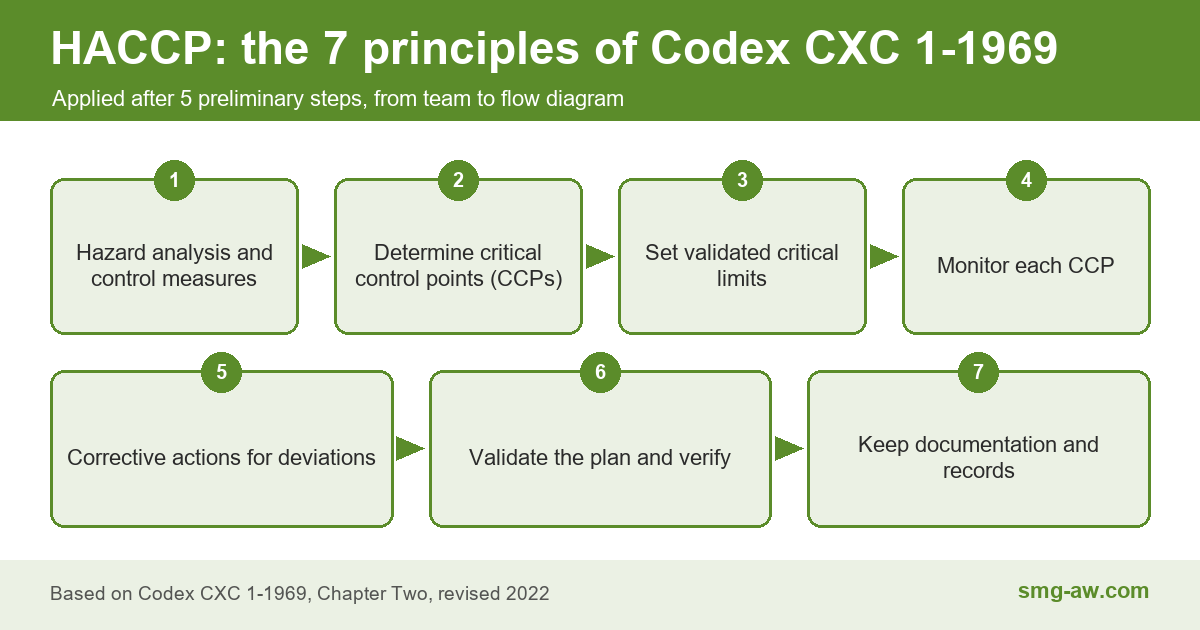
Codex sets five preliminary steps (form a team, describe the product, identify its intended use, draw a flow diagram and confirm it on site). The seven principles follow:
- Conduct a hazard analysis and identify control measures.
- Determine the critical control points (CCPs).
- Set validated critical limits for each CCP.
- Set up monitoring for each CCP.
- Set corrective actions for when monitoring shows a deviation.
- Validate the plan and set up verification.
- Keep documents and records.
The 2020 and 2022 revisions placed HACCP on a firm base of good hygiene practices and added tools to help decide what is a CCP.
What are the benefits of HACCP?
A HACCP plan targets the hazards that can harm consumers and gives buyers and authorities evidence that your controls are planned and checked. The main benefits are:
- A clear, risk-based plan that targets the hazards that can harm consumers.
- Evidence for authorities and buyers that your controls are planned and monitored.
- Support for a due diligence defense if a problem occurs.
- A first step towards ISO 22000, FSSC 22000 or BRCGS.
How can you show conformity to HACCP?
You show conformity to HACCP through a compliance audit against Codex CXC 1-1969, not a certificate. SMG audits your HACCP plan and records and reports how they meet the Codex principles.
SMG offers:
- HACCP compliance audit: an independent audit of your HACCP plan and records against Codex CXC 1-1969, with a written report of conformity and gaps.
- Gap assessment: a shorter review before a customer or authority inspection.
- Second-party audits: we audit your suppliers’ HACCP systems for you.
- Training: HACCP awareness and HACCP team courses.
If you need a certificate, ISO 22000 and FSSC 22000 include HACCP and can be certified.
HACCP vs ISO 22000 vs FSMA preventive controls
| Codex HACCP | ISO 22000:2018 + Amd 1:2024 | FSMA Preventive Controls | |
|---|---|---|---|
| Type | Code of practice | Certifiable management system standard | US regulation (21 CFR Part 117) |
| Focus | Hazards at critical control points | Whole food safety management system | Preventive controls, incl. allergens, sanitation and supply chain |
| Certificate | No, compliance audit | Yes | No, FDA inspection |
| Set by | Codex (FAO/WHO) | ISO | US FDA |
Frequently asked questions
Can I get HACCP certification?
HACCP itself is a Codex code of practice, not a certifiable standard, so SMG audits your HACCP system against it rather than certifying it. You receive a written compliance audit report. If your customer needs a certificate that includes HACCP, ISO 22000 and FSSC 22000 are certifiable and both build on the Codex HACCP principles.
What is the difference between HACCP and ISO 22000?
HACCP is a hazard control method for your process. ISO 22000:2018 with Amendment 1:2024 includes the HACCP principles and adds a full management system with leadership, objectives, internal audit, management review and continual improvement. HACCP is checked through a compliance audit, while ISO 22000 can be certified, so many businesses start with HACCP and move to ISO 22000 later.
Is HACCP mandatory?
In many countries it is in practice. Canada’s Safe Food for Canadians Regulations require many food businesses to keep a written preventive control plan based on HACCP principles. Food authorities in Saudi Arabia and the GCC, and most export buyers, also expect a HACCP-based approach. Check the rules for your sector and market, because they differ.
Which edition of Codex HACCP applies?
The current text is CXC 1-1969, General Principles of Food Hygiene, last revised in 2022. Chapter One covers good hygiene practices and Chapter Two covers the HACCP system and the guidelines for applying it. Older versions of the text have been replaced, so check that your HACCP plan and training refer to this revision.
How much does a HACCP compliance audit cost?
The cost depends on the time on site, which follows from the number of products, process lines and HACCP plans you run, plus travel. A small site with one HACCP plan needs much less time than a multi-line factory. SMG confirms the duration in a written quote and sends a report that lists any gaps against Codex.
How often should a HACCP plan be reviewed?
Codex expects you to review the HACCP plan whenever something changes, such as a new product, raw material, process, equipment or a newly identified hazard. You should also verify the plan on a regular basis to confirm it still works. Many businesses also book a yearly independent audit so customers and authorities see an outside view.
Related standards
- ISO 22000: Certifiable food safety management system built on the HACCP principles.
- FSSC 22000: GFSI-recognized scheme for clients who need a certificate.
- GHP: Good hygiene practices, Chapter One of the same Codex text.
- GMP: Manufacturing practices that sit under every HACCP plan.
- ISO 22002 series prerequisite programs: Sector PRPs that support HACCP plans.
- FSMA (US FDA): US preventive controls go beyond HACCP for exporters to the US.