Last updated: 19 November 2026
FSMA, the Food Safety Modernization Act, is a United States law signed in January 2011 that moved US food regulation from reacting to contamination to preventing it. The US Food and Drug Administration (FDA) enforces it through a set of rules, including Preventive Controls for Human Food (21 CFR Part 117), Preventive Controls for Animal Food, the Foreign Supplier Verification Program and the Food Traceability Rule, with traceability compliance required from 20 July 2028. FSMA applies to food facilities that sell into the US, wherever they are, including exporters in Canada, Saudi Arabia, Lebanon and the GCC. FSMA is a regulation, not a certifiable standard, so there is no FSMA certificate. Companies show compliance through their own records and FDA inspections, and many use an independent compliance audit to check readiness. SMG offers FSMA compliance audits, traceability readiness reviews and training. BRCGS Food Safety audits with the FSMA voluntary module are available through SMG Food Safety Solutions (SMGFSS).
Key facts
- Standard
- FSMA, US Food Safety Modernization Act
- Current edition
- FSMA (2011) and FDA rules, incl. 21 CFR Part 117 and 21 CFR Part 1 Subpart S
- Type
- Regulation
- Who it is for
- Food and feed facilities that sell into the US, and US importers
- Certificate and audit cycle
- No certificate: compliance shown by records, FDA inspection and independent audit
- Transition or revision status
- Food Traceability Rule compliance date moved to 20 July 2028
- Related standards
- Codex HACCP, FSSC 22000, BRCGS Food Safety (FSMA module), ISO 22005
- SMG service
- FSMA compliance audit, traceability readiness review, training. BRCGS with FSMA module through SMGFSS.
- Where SMG works
- North America: Canada, USA and Mexico. Middle East: Saudi Arabia, the GCC (UAE, Qatar, Kuwait, Bahrain, Oman), Lebanon and Türkiye. Europe: UK, Ireland, Belgium, Italy, Spain, Portugal, Austria and Switzerland. Africa: Egypt, Morocco, Tunisia, Algeria, Libya, Nigeria, Ghana, Côte d'Ivoire, Liberia, Congo (Kinshasa and Brazzaville), Kenya and South Africa. Asia: China, Japan, South Korea, Indonesia, Malaysia and Vietnam.
- Audit languages
- English, Spanish, French, Arabic, Mandarin, Cantonese, German and Italian. In other countries SMG works with qualified local auditors.
What is FSMA?
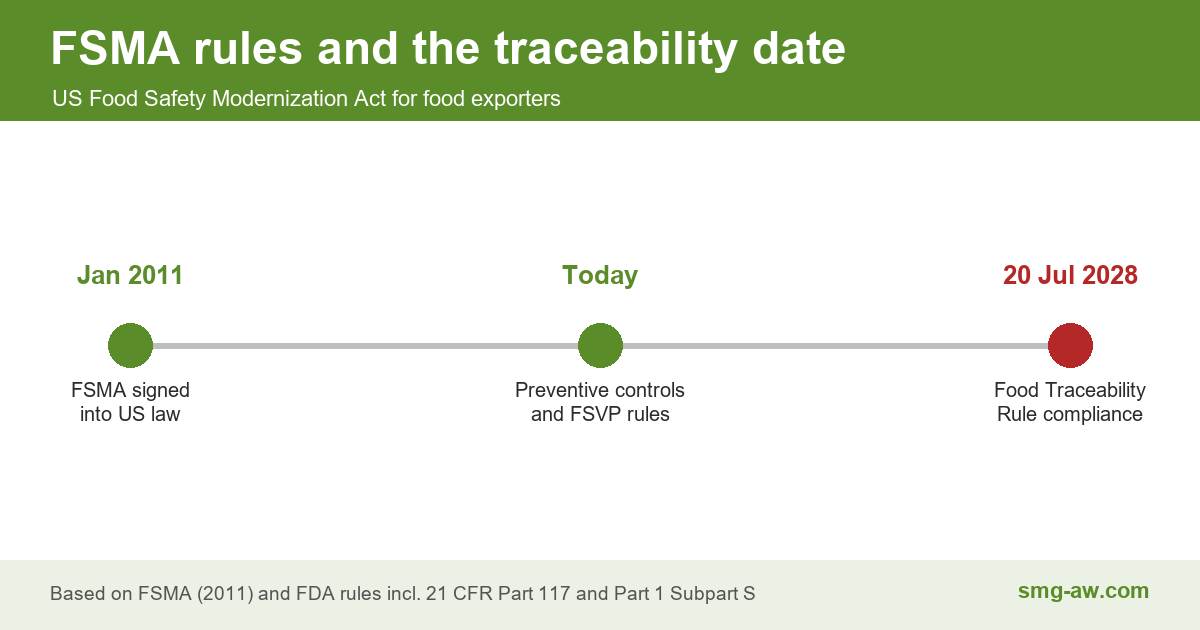
FSMA, the Food Safety Modernization Act, is a United States law signed in January 2011 that moved US food regulation from reacting to contamination to preventing it. It is enforced by the US Food and Drug Administration (FDA) through a set of rules.
FSMA is a regulation, not a certifiable standard. There is no FSMA certificate. Companies show compliance through their own records and FDA inspections, and many use an independent compliance audit to check they are ready.
What are the main FSMA rules?
FSMA works through a set of FDA rules, and the ones that matter most to exporters cover preventive controls, supplier verification and traceability. The main rules are:
- Preventive Controls for Human Food: a written food safety plan with hazard analysis and preventive controls, prepared by a preventive controls qualified individual.
- Preventive Controls for Animal Food: the matching rule for feed and pet food.
- Foreign Supplier Verification Program (FSVP): US importers must verify that their foreign suppliers meet US safety standards.
- Sanitary Transportation, Produce Safety and Intentional Adulteration rules.
- Food Traceability Rule: extra records for foods on the FDA Food Traceability List. Compliance is now required from 20 July 2028.
Who must comply with FSMA?
FSMA applies to food facilities that sell into the US, wherever they are. Food manufacturers in Canada, Saudi Arabia, Lebanon and the GCC that export to the US must meet the preventive controls rules. Their US importers will ask for evidence under FSVP, often in the form of an audit report or a GFSI-recognized certificate.
What are the benefits of an independent FSMA audit?
An independent FSMA audit shows your gaps before an FDA inspection or an importer’s review. The main benefits are:
- A clear view of gaps between your HACCP plan and the FSMA preventive controls rule.
- Evidence your US importer can use for FSVP supplier verification.
- Fewer surprises at an FDA inspection.
- Early preparation for the Food Traceability Rule.
How can you show compliance with FSMA?
You show FSMA compliance through your records and FDA inspections, and an independent compliance audit gives your importer extra evidence. There is no FSMA certificate.
SMG offers:
- FSMA compliance audit: we audit your food safety plan, preventive controls and records against the relevant FDA rule and report the gaps.
- Traceability readiness review for foods on the FDA Food Traceability List.
- BRCGS Food Safety certification with the FSMA voluntary module, issued through SMG Food Safety Solutions Inc. (SMGFSS).
- FSSC 22000 certification, which many US importers accept as part of supplier approval.
- Training on FSMA requirements for food safety teams.
FSMA compliance audit vs BRCGS FSMA module
| FSMA compliance audit | BRCGS FSMA voluntary module | |
|---|---|---|
| What it is | Independent audit against the relevant FDA rule | Extra module audited with BRCGS Food Safety |
| Output | Written gap report | Module result in the BRCGS audit report |
| Carried out by | SMG | SMG Food Safety Solutions (SMGFSS) |
| Needs BRCGS certification | No | Yes |
Frequently asked questions
Is there an FSMA certificate?
No. FSMA is a US regulation, so compliance is shown through your records and FDA inspections, not a certificate. An independent compliance audit, or a GFSI-recognized certificate such as BRCGS Food Safety with the FSMA module, gives your US importer supporting evidence for its supplier verification duties under FSVP.
What is the difference between HACCP and FSMA preventive controls?
HACCP controls hazards at critical control points. The FSMA preventive controls rule goes wider and can also require controls for allergens, sanitation and the supply chain, even where there is no critical control point. It also needs a preventive controls qualified individual to prepare or oversee the plan. A HACCP plan is a good start, not the full answer.
When does the FDA Food Traceability Rule apply?
Compliance with the Food Traceability Rule is required from 20 July 2028. The date was moved from January 2026, but the record-keeping requirements stayed the same. If you make, pack or hold foods on the FDA Food Traceability List for the US market, plan your key data elements and records now.
Does BRCGS help with FSMA?
Yes. BRCGS Food Safety has a voluntary FSMA module that is audited at the same visit as the main standard. It checks the extra requirements of the US preventive controls rule. SMG Food Safety Solutions (SMGFSS) can include the module in your BRCGS Food Safety audit, and the result appears in your BRCGS audit report.
Do Canadian exporters need FSMA compliance?
Yes, if they sell food into the US. Canadian facilities that export to the US must meet the relevant FSMA rules, and their US importers must verify them under FSVP. The US and Canada recognize each other’s food safety systems in some areas, so check with your importer which evidence they need.
How much does an FSMA compliance audit cost?
The cost depends on the rules in scope, the number of products and food safety plans, your site size and travel. A single site with one plan needs less time than a multi-product factory. SMG sends a written quote after you share these details, and the report sets out each gap against the FDA rule.
Related standards
- BRCGS: BRCGS Food Safety with the FSMA voluntary module, through SMGFSS.
- FSSC 22000: GFSI-recognized certificate that US importers often accept for FSVP.
- HACCP (Codex CXC 1-1969): The base that FSMA preventive controls build on.
- ISO 22005: Traceability design that supports the FDA Food Traceability Rule.