Last updated: 19 November 2026
ISO 26000 is the international guidance standard on social responsibility. The current edition is ISO 26000:2010, the first and only edition, published in 2010 by ISO, the International Organization for Standardization. It helps organizations understand what acting in a socially responsible way means and how to build it into their decisions and activities. It sets out seven principles, such as accountability, transparency and respect for human rights, and seven core subjects, from organizational governance and labor practices to the environment and community involvement. It is for every type of organization: companies, public bodies, NGOs and not-for-profits, of any size and in any country. ISO 26000 is not a management system standard, and ISO states that it is not intended for certification. An organization shows how it applies the guidance through a gap assessment or independent review. SMG is a certification body working under ISO/IEC 17021-1. It offers ISO 26000 gap assessments, reviews of ISO 26000 claims and training in Canada, Saudi Arabia, Lebanon and the GCC.
Key facts
- Standard
- ISO 26000 Guidance on social responsibility
- Current edition
- ISO 26000:2010 (first edition)
- Type
- Guidance (not intended for certification)
- Who it is for
- Every type of organization, public or private, of any size
- Certificate and audit cycle
- No certificate: conformity shown by audit
- Transition or revision status
- Current. Only edition, reviewed and confirmed by ISO
- Related standards
- ISO 14001:2026, ISO 45001:2018 + Amd 1:2024, ISO 37001:2025, ISO 37000:2021, ISO 20400:2017
- SMG service
- Gap assessment, review of ISO 26000 claims and training
- Where SMG works
- North America: Canada, USA and Mexico. Middle East: Saudi Arabia, the GCC (UAE, Qatar, Kuwait, Bahrain, Oman), Lebanon and Türkiye. Europe: UK, Ireland, Belgium, Italy, Spain, Portugal, Austria and Switzerland. Africa: Egypt, Morocco, Tunisia, Algeria, Libya, Nigeria, Ghana, Côte d'Ivoire, Liberia, Congo (Kinshasa and Brazzaville), Kenya and South Africa. Asia: China, Japan, South Korea, Indonesia, Malaysia and Vietnam.
- Audit languages
- English, Spanish, French, Arabic, Mandarin, Cantonese, German and Italian. In other countries SMG works with qualified local auditors.
What is ISO 26000?
ISO 26000:2010 is the international guidance standard on social responsibility. It helps organizations understand what acting in a socially responsible way means and how to build it into their decisions and activities.
ISO published it in 2010 and last reviewed and confirmed it in 2025. It is not a management system standard. ISO states clearly that it is not intended for certification, and any claim to be certified to ISO 26000 misrepresents it. You show how you apply it through a gap assessment or independent review.
Who needs ISO 26000?
ISO 26000 is for every type of organization that wants to understand and manage its social impacts: companies, public bodies, NGOs and not-for-profits, of any size, in any country.
Typical triggers include:
- Preparing a sustainability or ESG report.
- Customers or investors asking how you manage social and ethical impacts.
- Aligning with national programs such as Saudi Vision 2030 and sustainability agendas across the GCC.
- Reviewing supplier and community relationships in Canada, Lebanon or the wider region.
What are the benefits of ISO 26000?
ISO 26000 gives your leadership a shared map of social responsibility and the issues that matter most to stakeholders. The main benefits are:
- A shared understanding of social responsibility across your leadership team.
- A clear map of the issues that matter most to your stakeholders.
- Better relationships with employees, communities and customers.
- A structured basis for ESG and sustainability reporting.
- Links to certifiable systems that manage specific impacts, such as environment and safety.
What are the 7 principles and 7 core subjects of ISO 26000?
ISO 26000 sets out seven principles: accountability, transparency, ethical behavior, respect for stakeholder interests, respect for the rule of law, respect for international norms of behavior, and respect for human rights.
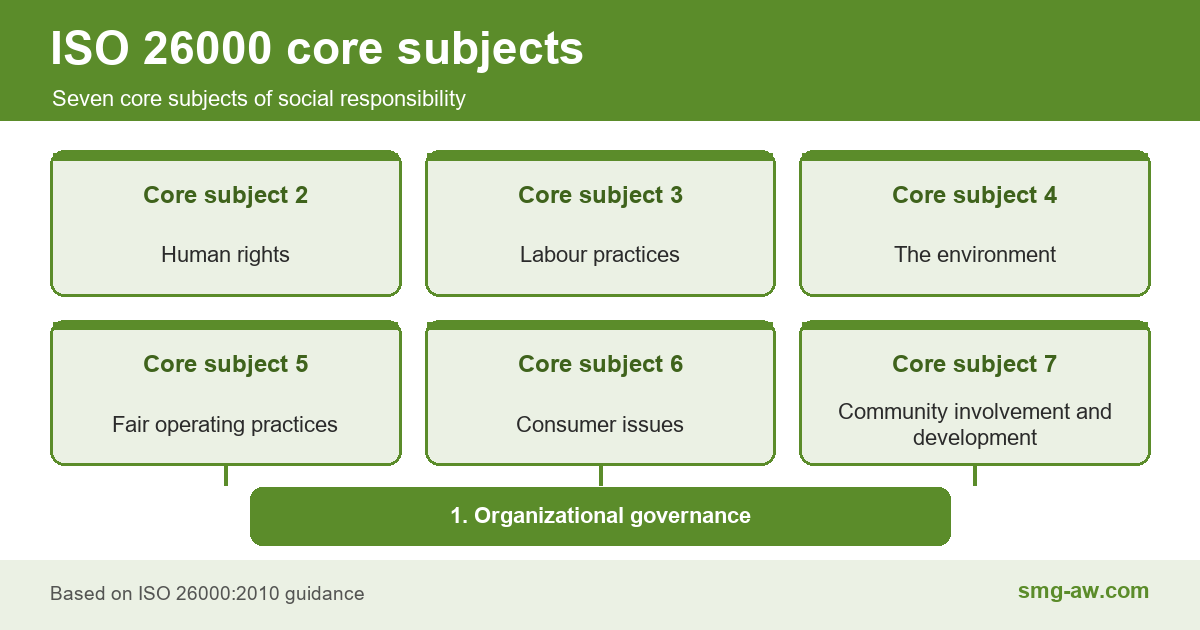
It groups issues into seven core subjects:
- Organizational governance.
- Human rights.
- Labor practices.
- The environment.
- Fair operating practices.
- Consumer issues.
- Community involvement and development.
The standard also explains how to identify and engage stakeholders and how to communicate on social responsibility.
How does ISO 26000 connect to other standards?
Several certifiable standards cover parts of ISO 26000 in more depth. ISO 14001 manages environmental impacts, ISO 45001 occupational health and safety, and ISO 37001 the anti-bribery part of fair operating practices.
ISO 37000 covers organizational governance. ISO 20400 gives guidance on sustainable procurement.
How can you show conformity to ISO 26000 with SMG?
You show how you apply ISO 26000 through an independent SMG assessment or review. We offer:
- Social responsibility gap assessment against the ISO 26000 principles and core subjects, with a written report.
- Independent review of public statements that refer to ISO 26000, so that they are accurate.
- Training for managers and sustainability teams.
SMG audits, certifies and trains.
ISO 26000 and certifiable standards for its core subjects
| ISO 26000 core subject | Related standard | Can you be certified? |
|---|---|---|
| The environment | ISO 14001:2026 | Yes |
| Labor practices (health and safety) | ISO 45001:2018 + Amd 1:2024 | Yes |
| Fair operating practices (anti-bribery) | ISO 37001:2025 | Yes |
| Organizational governance | ISO 37000:2021 | No (guidance) |
| All seven core subjects | ISO 26000:2010 | No (guidance) |
Frequently asked questions
Can we get ISO 26000 certification?
No. ISO states that ISO 26000:2010 is not intended or appropriate for certification. An offer to certify to it, or a claim to be certified, is a misuse of the standard. You can show how you apply it through a gap assessment or independent review. SMG gives you an independent report you can show clients, boards and regulators.
Is ISO 26000 still current?
Yes. ISO 26000:2010 is the first and only edition, and ISO has reviewed and confirmed it, so it remains current. It is still the main international reference for social responsibility. Many organizations use it alongside sustainability reporting frameworks to decide which social and environmental issues matter most to them.
Is ISO 26000 mandatory?
No. ISO 26000 is voluntary guidance. Laws on labor, the environment, consumer protection and anti-bribery are mandatory, and ISO 26000 covers each of these topics within its core subjects. Some sustainability reporting rules and investor questionnaires ask about social responsibility, and ISO 26000 gives a structured way to answer.
What is the difference between ISO 26000 and ISO 14001?
ISO 26000 gives broad guidance on social responsibility across seven core subjects and has no certificate. ISO 14001 sets requirements for an environmental management system and can be certified. The environment is one of the ISO 26000 core subjects, so ISO 14001 is a common way to manage that part in depth.
Can we mention ISO 26000 in our sustainability report?
Yes, if you describe it accurately, for example that your approach is guided by or aligned with ISO 26000. Do not say you are certified to it, because no certificate exists. An independent review can check your wording and the evidence behind it before the report is published.
What does an ISO 26000 gap assessment check?
It looks at how you apply the seven principles, which core subjects and issues are relevant to you, how you engage stakeholders and how you report. The assessor reviews policies and reports and interviews managers. You receive a written report of gaps and strengths.
Related standards
- ISO 14001: Environmental management certification for the environment core subject.
- ISO 45001: OH&S management certification that covers health and safety within labor practices.
- ISO 37001: Anti-bribery certification for the fair operating practices core subject.
- ISO 37000: Governance guidance for the organizational governance core subject.