Last updated: 19 November 2026
SMG takes your food site from an IFS Food Version 8 gap assessment to IFS Food certification. IFS Food is a food safety and quality standard for manufacturers that process food or pack loose food products. It is owned by IFS Management GmbH and was created by German, French and Italian retail federations. The current edition is IFS Food Version 8, mandatory for audits since 1 January 2024 and recognized by the Global Food Safety Initiative (GFSI). IFS Food uses Codex HACCP at its core and scores each requirement, so buyers see your level of performance. It suits food manufacturers, private label producers and exporters that supply European retailers, especially in Germany, France and Italy. IFS Food certification follows an audit repeated every year. SMG offers IFS Food Version 8 gap assessments, second-party supplier audits and training for food businesses in Canada, Lebanon, Saudi Arabia and the GCC.
Key facts
- Standard
- IFS Food
- Current edition
- IFS Food Version 8
- Published by
- IFS Management GmbH (scheme owner)
- Type
- Scheme: GFSI-recognized food safety and quality standard
- Who it is for
- Food manufacturers and packers of loose food, private label producers, exporters to European retail
- Certificate and audit cycle
- Annual certification audit and certificate
- Transition or revision status
- Version 8 mandatory since 1 January 2024. IFS doctrine updated April 2026.
- Related standards
- BRCGS Food Safety, FSSC 22000, ISO 22000, Codex HACCP
- SMG service
- Gap assessment, IFS Food certification, supplier audits and training
- Where SMG works
- North America: Canada, USA and Mexico. Middle East: Saudi Arabia, the GCC (UAE, Qatar, Kuwait, Bahrain, Oman), Lebanon and Türkiye. Europe: UK, Ireland, Belgium, Italy, Spain, Portugal, Austria and Switzerland. Africa: Egypt, Morocco, Tunisia, Algeria, Libya, Nigeria, Ghana, Côte d'Ivoire, Liberia, Congo (Kinshasa and Brazzaville), Kenya and South Africa. Asia: China, Japan, South Korea, Indonesia, Malaysia and Vietnam.
- Audit languages
- English, Spanish, French, Arabic, Mandarin, Cantonese, German and Italian. In other countries SMG works with qualified local auditors.
What is IFS Food?
IFS Food is a food safety and quality standard for manufacturers that process food or pack loose products. It was created by German, French and Italian retail federations and is now owned by IFS Management GmbH.
The current edition is IFS Food Version 8, which has been mandatory for audits since 1 January 2024. It is recognized by the Global Food Safety Initiative (GFSI).
Who needs IFS Food?
You need IFS Food when a retailer, especially in Germany, France or Italy, lists it as a condition of supply. Typical users are:
- Food manufacturers that supply European retailers, especially in Germany, France and Italy.
- Private label and own-brand producers.
- Companies that pack or process loose food products.
- Exporters from Canada, Lebanon, Saudi Arabia and the GCC entering European supply chains.
The usual trigger is a buyer that lists IFS Food as a condition of supply.
What are the benefits of IFS Food?
IFS Food gives you access to retailers that require it and a scored result that shows buyers your level of performance. The main benefits are:
- Access to retailers that require IFS Food from their suppliers.
- A risk-based standard that focuses on product safety, quality and specifications.
- A scoring system that shows buyers your level of performance.
- An optional unannounced audit route, which some retailers value.
- A strong product safety culture, with defined objectives in Version 8.
How does IFS Food connect to other standards?
IFS Food uses Codex HACCP as its core hazard control method. It is one of several GFSI-recognized options, alongside BRCGS and FSSC 22000, so many suppliers compare the three before they choose. Sites that already hold ISO 22000 will find much of the management system already in place.
How does IFS Food certification work with SMG?
SMG takes your site from a gap assessment against IFS Food Version 8 to IFS Food certification. The route covers:
- Gap assessment: a pre-audit of your site against IFS Food Version 8, with scored findings and a list of gaps.
- Supplier audits: second-party audits of your suppliers against IFS-style criteria.
- Training: IFS Food Version 8 requirements for quality and production teams.
- IFS Food certification: once your gaps are closed, your site moves on to the IFS Food certification audit, repeated every year.
If your buyers accept other GFSI-recognized standards, ask about our FSSC 22000 certification or BRCGS certification through SMGFSS.
IFS Food vs BRCGS Food Safety vs FSSC 22000
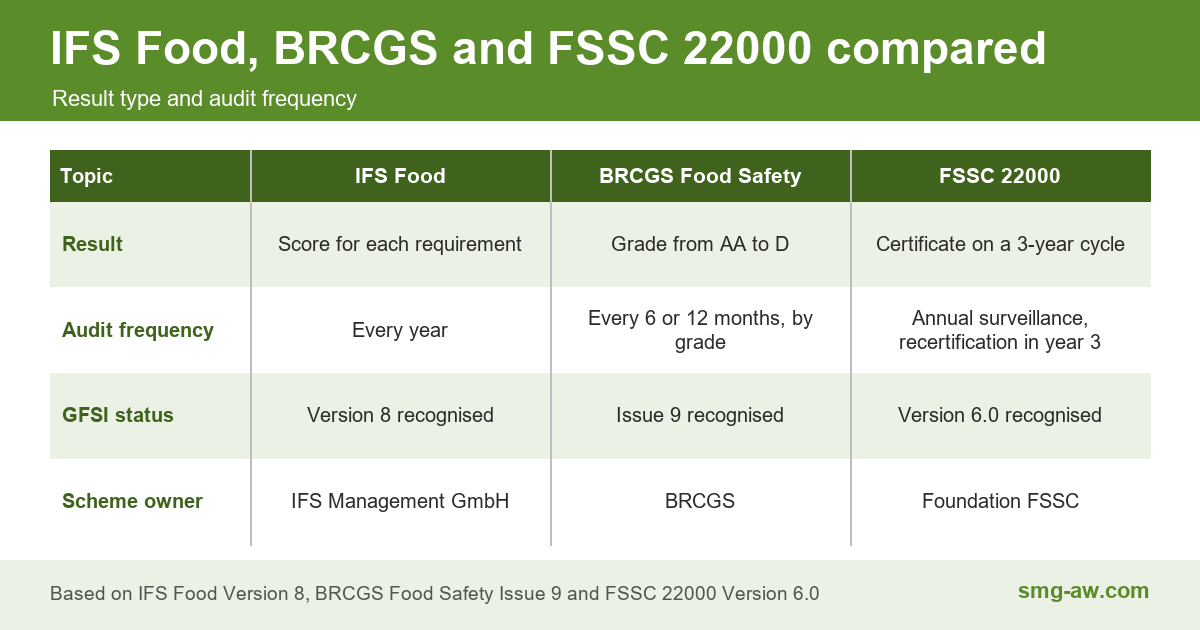
| IFS Food Version 8 | BRCGS Food Safety Issue 9 | FSSC 22000 | |
|---|---|---|---|
| Owner | IFS Management GmbH | BRCGS | Foundation FSSC |
| Result | Scored, Foundation or Higher level | Grade from AA to D | Certificate without a grade |
| Audit frequency | Every year | Every 6 or 12 months | 3-year cycle with annual surveillance |
| Route with SMG | Gap assessment through to IFS Food certification | Certification through SMGFSS | Certification by SMG |
Frequently asked questions
Can SMG take my site through to IFS Food certification?
Yes. SMG takes your site from a gap assessment against IFS Food Version 8 to IFS Food certification. We score each requirement, list your gaps and train your team, so you are ready for the certification audit. If your buyers accept other GFSI-recognized standards, ask about FSSC 22000 or BRCGS certification in the SMG group.
Which version of IFS Food is current?
IFS Food Version 8 is current. It has been mandatory for audits since 1 January 2024 and was recognized by GFSI in September 2024. IFS updates its doctrine, the interpretation guidance, from time to time, most recently in April 2026, so check that your team works from the latest documents.
What changed in IFS Food Version 8?
Version 8 redefined the B score as a deviation, introduced an IFS Star status for sites that take unannounced audits and deepened the food safety culture requirements. It also returned to the word audit in place of assessment. Check the full change list on the IFS website before your gap assessment.
What is the difference between IFS Food, BRCGS and FSSC 22000?
All three are GFSI-recognized. IFS Food is scored and popular with German, French and Italian retailers. BRCGS Food Safety is graded and widely used by UK and North American retailers. FSSC 22000 follows the ISO 22000 structure without grades. The right choice depends on what your main buyers ask for, so check their supplier requirements first.
How much does an IFS Food gap assessment cost?
The cost depends on the days on site, which follow from your site size, number of product scopes and production lines, and travel. A small single-line site needs less time than a large multi-line factory. SMG sends a written quote once you share these details, and the report scores each requirement so you can plan your fixes.
Is IFS Food mandatory?
No law requires IFS Food. It is a voluntary standard, but many European retailers make it a condition of supply for own-brand and private label products. If your buyer asks for it, you need an IFS Food certificate. Food safety laws in your own country and your export market still apply.
Related standards
- FSSC 22000: GFSI-recognized alternative that SMG certifies.
- BRCGS: GFSI-recognized alternative certified through SMGFSS.
- ISO 22000: Management system base that eases IFS Food readiness.
- HACCP (Codex CXC 1-1969): Hazard control method at the core of IFS Food.