Last updated: 19 November 2026
ISO 14001 is the international standard that sets the requirements for an environmental management system (EMS). The current edition is ISO 14001:2026, published in April 2026 by ISO, the International Organization for Standardization. It replaces ISO 14001:2015 and its 2024 climate action amendment, and certified organizations have until 30 April 2029 to move to it. ISO 14001 helps an organization control its environmental aspects, meet its compliance obligations and improve its environmental performance. Factories, contractors, logistics firms, hotels, hospitals, offices and public bodies use it, often because a tender, a permit or an investor asks for it. ISO 14001 is certifiable. A certification body audits your system in two stages, issues a three-year certificate and checks it with yearly surveillance audits. SMG is an international certification body. It certifies ISO 14001 systems for clients in Canada, Saudi Arabia, Lebanon and the GCC, and runs ISO 14001 awareness and internal auditor training.
Key facts
- Standard
- ISO 14001 Environmental management systems - Requirements with guidance for use
- Current edition
- ISO 14001:2026 (published April 2026)
- Type
- Certifiable management system standard
- Who it is for
- Any organization, of any size or sector, that affects the environment
- Certificate and audit cycle
- Three-year certificate: Stage 1 and Stage 2, yearly surveillance, recertification in year 3
- Transition or revision status
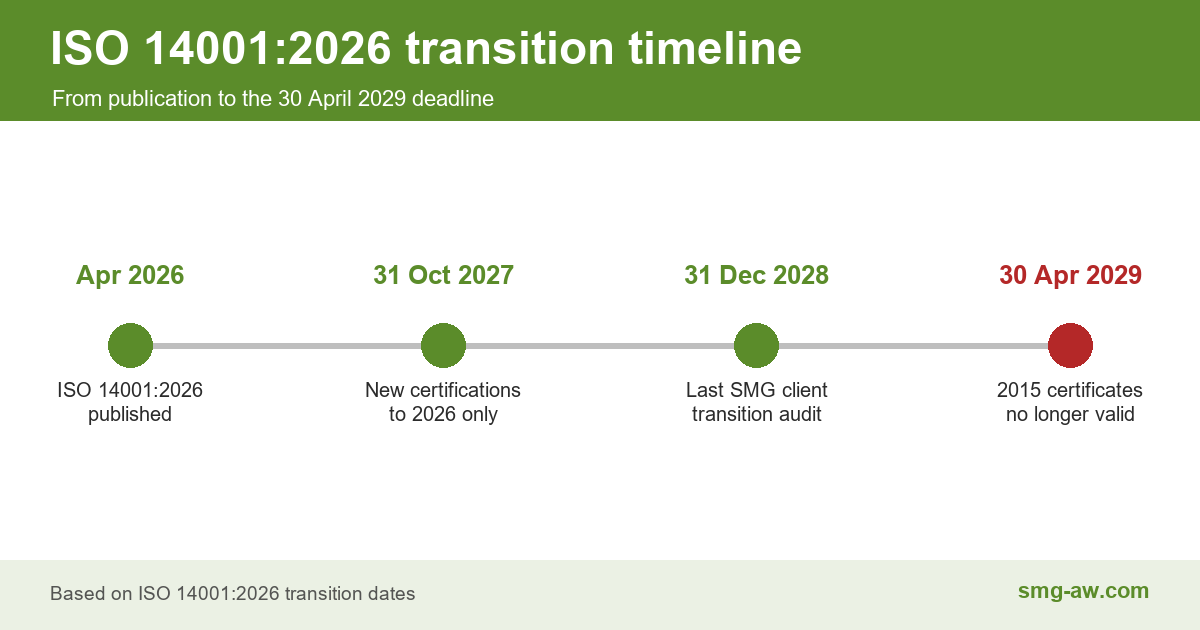
- Replaces ISO 14001:2015 + Amd 1:2024. New certifications to 2026 only from 31 October 2027. 2015 certificates end on 30 April 2029
- Related standards
- ISO 9001:2026, ISO 45001:2018 + Amd 1:2024, ISO 50001, ISO 14064-1, ISO 14005
- SMG service
- Certification, transition audits and training
- Where SMG works
- North America: Canada, USA and Mexico. Middle East: Saudi Arabia, the GCC (UAE, Qatar, Kuwait, Bahrain, Oman), Lebanon and Türkiye. Europe: UK, Ireland, Belgium, Italy, Spain, Portugal, Austria and Switzerland. Africa: Egypt, Morocco, Tunisia, Algeria, Libya, Nigeria, Ghana, Côte d'Ivoire, Liberia, Congo (Kinshasa and Brazzaville), Kenya and South Africa. Asia: China, Japan, South Korea, Indonesia, Malaysia and Vietnam.
- Audit languages
- English, Spanish, French, Arabic, Mandarin, Cantonese, German and Italian. In other countries SMG works with qualified local auditors.
What is ISO 14001?
ISO 14001 is the international standard that sets the requirements for an environmental management system (EMS). The current edition is ISO 14001:2026, published by ISO in April 2026. An independent certification body audits your system against it and issues a certificate if you meet the requirements.
ISO 14001:2026 replaces ISO 14001:2015 and its 2024 climate action amendment. Certified organizations have until 30 April 2029 to move to the new edition.
Who needs ISO 14001 certification?
Any organization that affects the environment can use ISO 14001, and many need the certificate for tenders or permits. It suits factories, contractors and logistics firms as well as hotels, hospitals, offices and public bodies.
Common reasons to seek it:
- A tender, government contract or large customer asks for an ISO 14001 certificate.
- Environmental permits, waste rules or emissions reporting are getting stricter.
- Investors, lenders or clients ask about your environmental performance.
- You already hold ISO 9001 or ISO 45001 and want one integrated system.
What are the benefits of ISO 14001?
ISO 14001 helps you control your environmental impacts and meet your legal obligations, with independent evidence for others. The main benefits are:
- You know your significant environmental aspects and control them.
- Legal and other compliance obligations are tracked and evaluated.
- Use of energy, water and materials becomes visible and easier to reduce.
- Emergencies such as spills or fires are planned for.
- Customers and tender panels see independent evidence of environmental control.
- Climate change is considered as part of your context.
How does ISO 14001 connect to other standards?
ISO 14001 shares its structure with ISO 9001 and ISO 45001, and many clients run one integrated audit.
ISO 50001 goes deeper on energy performance. ISO 14064-1 covers greenhouse gas inventories, which many EMS users report. ISO 14005 gives guidance on building an EMS in phases, which suits smaller organizations. ISO 20400 gives guidance on sustainable procurement.
How does ISO 14001 certification work with SMG?
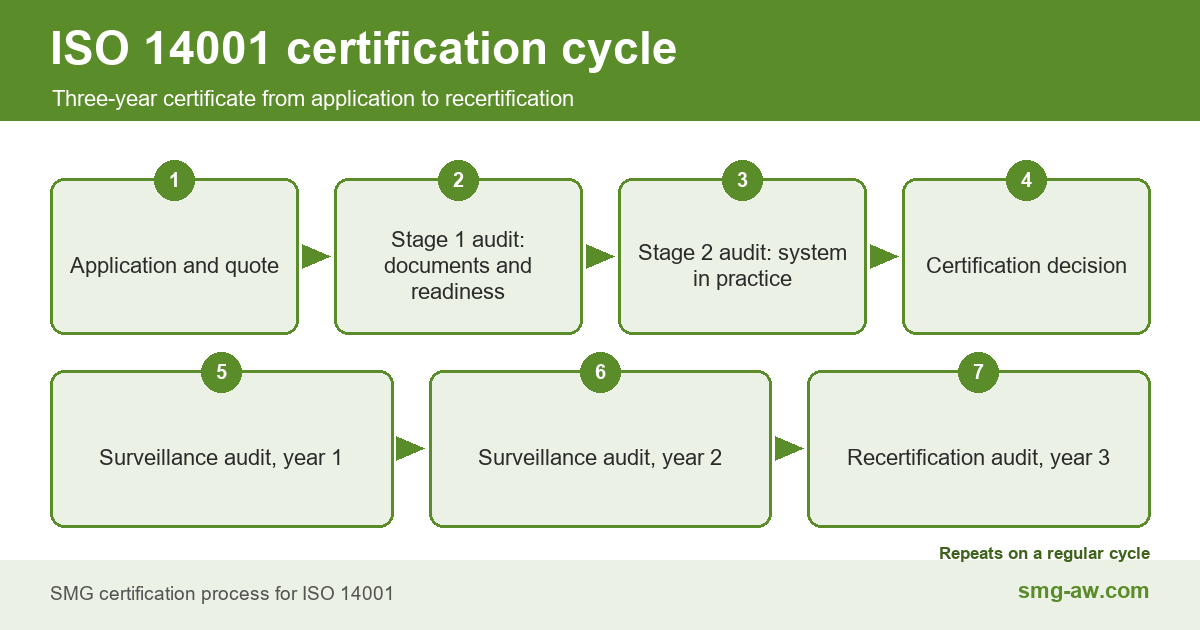
SMG certifies your ISO 14001 system through a three-year cycle of audits, run under ISO/IEC 17021-1. We serve clients in Canada, Saudi Arabia, Lebanon and the GCC.
SMG certifies to ISO 14001:2026. Clients certified to ISO 14001:2015 move to the new edition through a transition audit.
The certification cycle has six steps, in this order:
- Application and quote. You tell us your scope, sites and staff numbers. Audit time also reflects the nature of your environmental aspects.
- Stage 1 audit. We review your documented system, your aspects and compliance obligations, and check that you are ready.
- Stage 2 audit. We check that the system works in practice at your sites.
- Certification decision. A qualified person who did not take part in the audit reviews the file and decides.
- Surveillance audits. We audit part of the system every year.
- Recertification. In year three we audit the full system again before the certificate expires.
SMG audits, certifies and trains. Our public and in-house training includes ISO 14001 awareness and internal auditor courses.
ISO 14001:2015 vs ISO 14001:2026: main changes
| Topic | ISO 14001:2015 + Amd 1:2024 | ISO 14001:2026 |
|---|---|---|
| Structure and terms | 2015 high-level structure | Updated ISO harmonized structure and terms |
| Climate change | Added to 4.1 and 4.2 by the 2024 amendment | Built into clauses 4.1 and 4.2 |
| Planning of changes | No separate clause | New clause 6.3 on planning changes to the EMS |
| Management review (9.3) | Single clause | New sub-clauses |
| Annex A guidance | Shorter guidance | More guidance on context, life cycle thinking and strategy |
Frequently asked questions
What is the current edition of ISO 14001?
ISO 14001:2026 is the current edition, published by ISO in April 2026. It replaces ISO 14001:2015 and its 2024 climate action amendment. ISO 14001:2015 certificates stay valid during the transition, which ends on 30 April 2029. From 31 October 2027, new certifications are to ISO 14001:2026 only.
How long does ISO 14001 certification take?
It depends on how ready your system is, your size and the nature of your environmental aspects. Your system should run for a period and complete an internal audit and a management review before the audits start. Audit days follow international rules on audit time. The decision follows once any major nonconformities are closed.
What does the cost of ISO 14001 certification depend on?
The cost depends mainly on the number of audit days. These follow international rules on audit time and reflect your staff numbers, sites and the complexity of your environmental aspects. Travel, shifts and combined audits with ISO 9001 or ISO 45001 also affect the price. SMG sends a written quote for the full three-year cycle.
Is ISO 14001 certification mandatory?
No. ISO 14001 certification is voluntary, and no general law requires it. Environmental laws and permits are mandatory, and ISO 14001 helps you meet them. Many tenders, government contracts and large customers ask for a valid ISO 14001 certificate, so it can become a condition for winning work.
Does ISO 14001 set environmental performance limits?
No. ISO 14001 does not set emission, discharge or waste limits. It asks you to identify your environmental aspects, meet your legal and other obligations, set your own objectives and improve your system over time. Your permits, licenses and local environmental law set the actual limits you must meet.
Can I get certified to ISO 14001:2026 now?
You can align your system with the 2026 edition now. Tell us when you expect to be ready. You move to ISO 14001:2026 through a transition audit, which can be combined with a surveillance or recertification audit.
Related standards
- ISO 14001:2026 transition: What changed in the 2026 edition, the deadlines and how SMG runs the transition audit
- ISO 9001: Quality management system with the same structure, often audited with ISO 14001
- ISO 45001: Health and safety system that shares hazards and emergency planning with an EMS
- ISO 50001: Energy management system for deeper control of energy use
- ISO 14005: Guidance on building an EMS in phases