Last updated: 19 November 2026
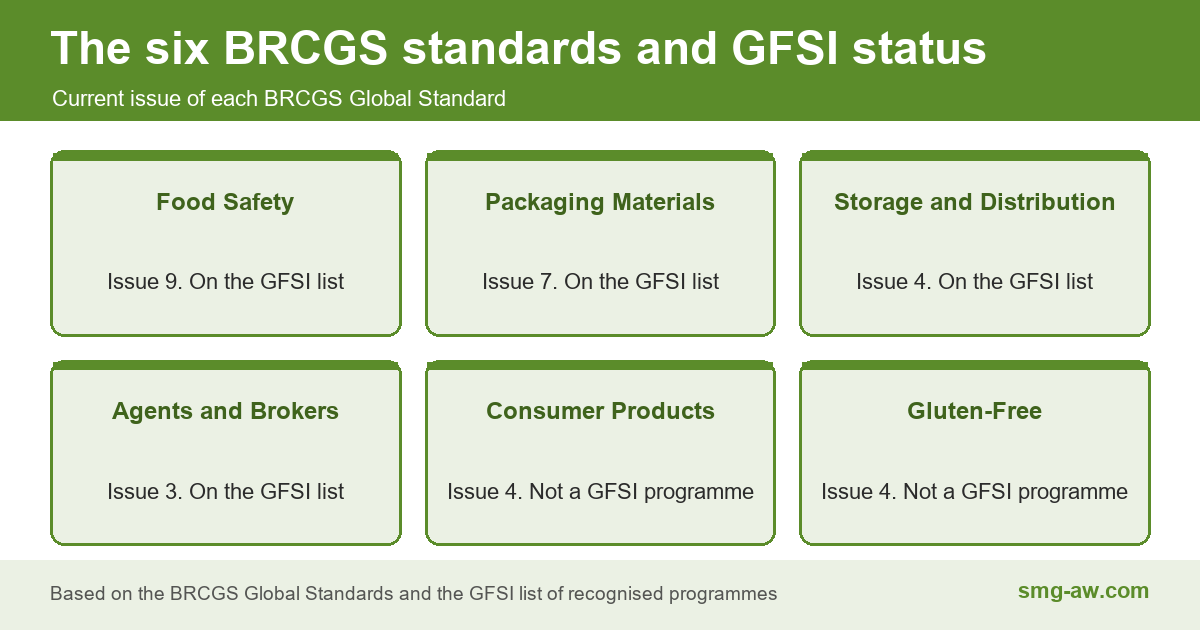
BRCGS certification is independent proof that a site meets one of the BRCGS Global Standards, owned by BRCGS, formerly the British Retail Consortium Global Standards. The current standards are Food Safety Issue 9, Packaging Materials Issue 7, Storage and Distribution Issue 4, Agents and Brokers Issue 3, Consumer Products Issue 4 and Gluten-Free Issue 4. Food Safety, Packaging Materials, Storage and Distribution, and Agents and Brokers appear on the Global Food Safety Initiative (GFSI) list of recognized programs. BRCGS suits food manufacturers, packaging makers, warehouses and logistics firms, traders and brokers, consumer goods manufacturers and gluten-free producers. BRCGS works differently from ISO certification. There is one full audit, the site receives a grade, usually from AA to D, and it is re-audited every 6 or 12 months depending on the grade and the Standard. Results are listed in the BRCGS Directory. In the SMG group, BRCGS certificates are issued by SMG Food Safety Solutions (SMGFSS) for clients in Canada, Saudi Arabia, Lebanon and the GCC.
Key facts
- Standard
- BRCGS Global Standards
- Current edition
- Food Safety Issue 9, Packaging Materials Issue 7, Storage and Distribution Issue 4, Agents and Brokers Issue 3, Consumer Products Issue 4, Gluten-Free Issue 4
- Published by
- BRCGS (scheme owner)
- Type
- Scheme: product and process certification standards
- Who it is for
- Food and packaging manufacturers, warehouses and logistics, traders and brokers, consumer goods makers, gluten-free producers
- Certificate and audit cycle
- Single full audit with a grade. Re-audit every 6 or 12 months by grade and Standard.
- Transition or revision status
- Food Safety Issue 10 in development, no date announced. Consumer Products Issue 5 published 13 October 2026, audits from 1 June 2027.
- Related standards
- FSSC 22000, ISO 22000, Codex HACCP, FSMA
- SMG service
- Certification issued by SMG Food Safety Solutions (SMGFSS).
- Where SMG works
- North America: Canada, USA and Mexico. Middle East: Saudi Arabia, the GCC (UAE, Qatar, Kuwait, Bahrain, Oman), Lebanon and Türkiye. Europe: UK, Ireland, Belgium, Italy, Spain, Portugal, Austria and Switzerland. Africa: Egypt, Morocco, Tunisia, Algeria, Libya, Nigeria, Ghana, Côte d'Ivoire, Liberia, Congo (Kinshasa and Brazzaville), Kenya and South Africa. Asia: China, Japan, South Korea, Indonesia, Malaysia and Vietnam.
- Audit languages
- English, Spanish, French, Arabic, Mandarin, Cantonese, German and Italian. In other countries SMG works with qualified local auditors.
What is BRCGS certification?
BRCGS certification is independent proof that your site meets one of the BRCGS Global Standards for food, packaging, storage and distribution, trading, consumer products or gluten-free production. A certification body audits your site, grades the result and lists it in the BRCGS Directory, where your customers can check it.
BRCGS began as the British Retail Consortium Global Standards. Its Food Safety Standard alone is used by more than 22,000 sites in over 130 countries, according to BRCGS.
Which BRCGS standards exist, and which are GFSI-recognized?
BRCGS runs six certification standards, each for a different part of the supply chain. Four of them appear on the GFSI list of recognized programs, while Consumer Products and Gluten-Free sit outside GFSI.
- Food Safety Issue 9: food and pet food manufacturers, processors and packers. Recognized by the Global Food Safety Initiative (GFSI).
- Packaging Materials Issue 7: makers of packaging for food and non-food products. GFSI lists the Packaging Materials Standard as recognized, and its entry currently names Issue 6.
- Storage and Distribution Issue 4: warehouses, logistics and transport operations. Recognized by GFSI.
- Agents and Brokers Issue 3: traders who buy and sell products without making or storing them. Recognized by GFSI.
- Consumer Products Issue 4: manufacturers of non-food consumer goods. Not part of GFSI, which benchmarks food safety programs. BRCGS published Consumer Products Issue 5 on 13 October 2026. Audits to Issue 5 start on 1 June 2027. Until 31 May 2027, audits are carried out against Issue 4. An audit that starts on 31 May 2027 and ends after that date is carried out against Issue 5.
- Gluten-Free Issue 4: food sites that make gluten-free claims. It sits on top of your food safety certification and is not a GFSI program.
How do you choose the right BRCGS standard?
Choose the BRCGS standard that matches what your site does with the product: make it, pack it, store it, trade it or make a gluten-free claim.
- You make, process or pack food: Food Safety.
- You make packaging or packaging materials: Packaging Materials.
- You store, move or ship products made by others: Storage and Distribution.
- You trade products but never hold them in your own facility: Agents and Brokers.
- You make non-food goods for consumers: Consumer Products.
- You make gluten-free products and want a recognized trademark on pack: Gluten-Free, alongside Food Safety.
Many businesses hold two schemes, for example a food factory with a separate distribution center. Your customer’s specification usually settles the choice, so check it first.
How do BRCGS audits, grades and re-audits work?
A BRCGS audit is a single full audit that ends in a grade, and the grade sets how soon you are re-audited. You choose the audit route first.
Most BRCGS schemes offer three audit routes.
- Announced: a full audit on a date agreed with you.
- Blended announced: a remote review of documents and records using video and file sharing, then an on-site audit.
- Unannounced: the audit happens without notice and the grade carries a plus, such as AA+.
Sites certified to Food Safety, Packaging Materials or Storage and Distribution must also have at least one unannounced audit every three years to meet the GFSI benchmark.
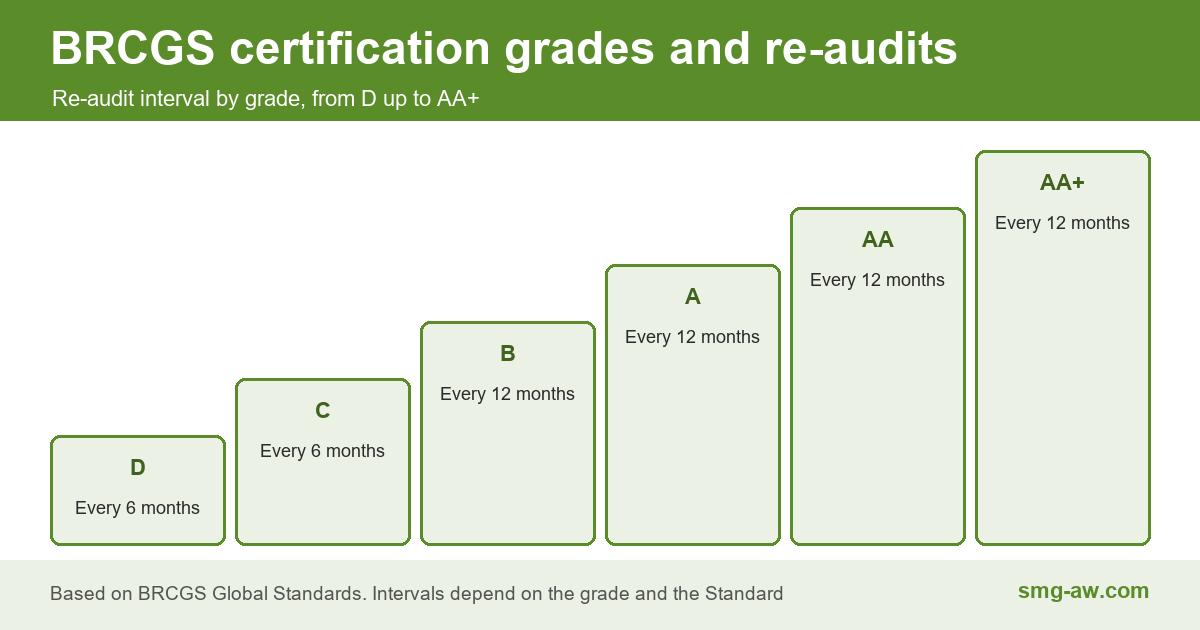
Grades run from AA to D (AA to C for Agents and Brokers), based on the number and severity of nonconformities. Higher grades are re-audited every 12 months and lower grades every 6 months. Consumer Products sites are audited every 12 months whatever the grade.
How does BRCGS compare with ISO 22000 and FSSC 22000?
BRCGS Food Safety and FSSC 22000 are both GFSI-recognized choices for food manufacturers. FSSC 22000 is built on ISO 22000 and is not graded, while BRCGS is more prescriptive and graded. Both use HACCP at their core. ISO 22000 is the food safety management system standard behind FSSC 22000, and many BRCGS sites run it alongside.
How does BRCGS certification work with SMGFSS?
BRCGS certificates in the SMG group are issued by SMG Food Safety Solutions Inc. (SMGFSS), the certification body arm of SMG.
- Application: you describe your site, products and processes, and we confirm the scheme, categories and audit duration.
- Audit option: you choose announced, blended or unannounced, within the scheme rules.
- Audit: a BRCGS-registered auditor qualified for your category audits your site.
- Corrective action: you send objective evidence within the time the Standard sets, usually 28 calendar days.
- Certification decision: an SMGFSS reviewer who did not audit your site decides, issues the certificate and grade, and uploads the report to the BRCGS Directory.
- Re-audit: every 12 or 6 months, depending on your grade and scheme.
The six BRCGS standards at a glance
| Standard | Current issue | Who it is for | GFSI status |
|---|---|---|---|
| Food Safety | Issue 9 | Food and pet food manufacturers | Recognized |
| Packaging Materials | Issue 7 | Packaging makers | Recognized (GFSI entry names Issue 6) |
| Storage and Distribution | Issue 4 | Warehouses and logistics | Recognized |
| Agents and Brokers | Issue 3 | Traders, importers and brokers | Recognized |
| Consumer Products | Issue 4 (Issue 5 from 1 Jun 2027) | Non-food consumer goods makers | Not a GFSI program |
| Gluten-Free | Issue 4 | Sites making gluten-free claims | Not a GFSI program |
Frequently asked questions
Which BRCGS standards are recognized by GFSI?
GFSI lists BRCGS Food Safety Issue 9, Storage and Distribution Issue 4, Agents and Brokers Issue 3 and the Packaging Materials Standard as recognized. The Packaging Materials entry currently names Issue 6. Consumer Products and Gluten-Free are not GFSI programs. Check mygfsi.com for the latest status before you rely on it in a supplier contract.
What do BRCGS grades mean?
The grade reflects the number and severity of nonconformities found at the audit. AA is the best result, and most standards grade down to D. Unannounced audits add a plus, such as AA+. Lower grades mean more frequent audits, usually every 6 months instead of every 12, so a good grade also saves audit cost.
How long does BRCGS certification take?
Most sites need a few months to meet the Standard and build records before the first audit. The audit length depends on the site, the products and the Standard. You then send corrective action evidence, usually within 28 calendar days, and SMGFSS makes the certification decision once the evidence is accepted.
How much does BRCGS certification cost?
The cost depends on the audit duration, which follows from the Standard, your site size, number of employees, product categories and HACCP plans, plus travel. Scheme owner fees may also apply. Your grade affects cost over time, because lower grades mean more audits. SMGFSS confirms the Standard and categories first, then sends a written quote.
Is BRCGS certification mandatory?
No law requires BRCGS certification. It is a voluntary standard, but many retailers and brand owners in the UK, Europe and North America make it, or another GFSI-recognized scheme, a condition of supply. If your customer specifies BRCGS, you need a BRCGS certificate, and SMGFSS issues it in the SMG group.
When is BRCGS Food Safety Issue 10 due?
BRCGS is developing Issue 10 but has not announced a publication date or an audit start date. Until it does, Issue 9 is the version you are audited against. A new issue normally comes with a transition period of several months, and SMGFSS will publish the dates and the main changes once BRCGS confirms them.
Related standards
- BRCGS Food Safety Issue 9: Scheme page for food and pet food manufacturers.
- BRCGS Packaging Materials Issue 7: Scheme page for packaging manufacturers.
- BRCGS Storage and Distribution Issue 4: Scheme page for warehousing and logistics.
- BRCGS Agents and Brokers Issue 3: Scheme page for traders, importers and brokers.
- BRCGS Consumer Products: Scheme page for non-food consumer goods manufacturers.
- BRCGS Gluten-Free Certification Programme: Scheme page for sites making gluten-free claims.
- FSSC 22000: The other main GFSI-recognized scheme for food manufacturers.
- ISO 22000: Food safety management system many BRCGS sites run alongside.
- HACCP: The hazard analysis method at the core of every BRCGS food standard.