Last updated: 19 November 2026
GMP (Good Manufacturing Practices) for food are the basic hygiene and operating conditions a food factory needs to produce safe food. They cover the building, equipment, cleaning and pest control. They also cover staff hygiene, allergen control and how materials move through the site. Food GMP is not a single certifiable standard. The main references are the Codex General Principles of Food Hygiene, CXC 1-1969, last revised in 2022 by FAO and WHO, and the ISO prerequisite program standards ISO 22002-100:2025 and ISO 22002-1:2025. National food laws add their own rules. GMP suits food and drink manufacturers, ingredient producers, contract packers and new businesses preparing for HACCP or a GFSI scheme. There is no GMP certificate under these texts, so you show conformity through a compliance audit. SMG offers food GMP compliance audits, gap assessments, second-party supplier audits and training in Canada, Saudi Arabia, Lebanon and the GCC. If you need a certificate, ISO 22000 and FSSC 22000 include GMP-type controls and can be certified.
Key facts
- Standard
- GMP (Good Manufacturing Practices) for food
- Current edition
- Codex CXC 1-1969 (rev. 2022), ISO 22002-100:2025 and ISO 22002-1:2025
- Published by
- Codex Alimentarius Commission (FAO/WHO) and ISO
- Type
- Good practice code and PRP requirements, not certifiable on their own
- Who it is for
- Food and drink manufacturers, ingredient producers, contract packers, new food businesses
- Certificate and audit cycle
- No certificate: conformity shown by a compliance audit
- Transition or revision status
- Codex text revised 2022. ISO 22002 parts published 2025.
- Related standards
- HACCP, GHP, ISO 22002 series, ISO 22000, FSSC 22000
- SMG service
- GMP compliance audit, gap assessment, second-party audits, training
- Where SMG works
- North America: Canada, USA and Mexico. Middle East: Saudi Arabia, the GCC (UAE, Qatar, Kuwait, Bahrain, Oman), Lebanon and Türkiye. Europe: UK, Ireland, Belgium, Italy, Spain, Portugal, Austria and Switzerland. Africa: Egypt, Morocco, Tunisia, Algeria, Libya, Nigeria, Ghana, Côte d'Ivoire, Liberia, Congo (Kinshasa and Brazzaville), Kenya and South Africa. Asia: China, Japan, South Korea, Indonesia, Malaysia and Vietnam.
- Audit languages
- English, Spanish, French, Arabic, Mandarin, Cantonese, German and Italian. In other countries SMG works with qualified local auditors.
What is GMP?
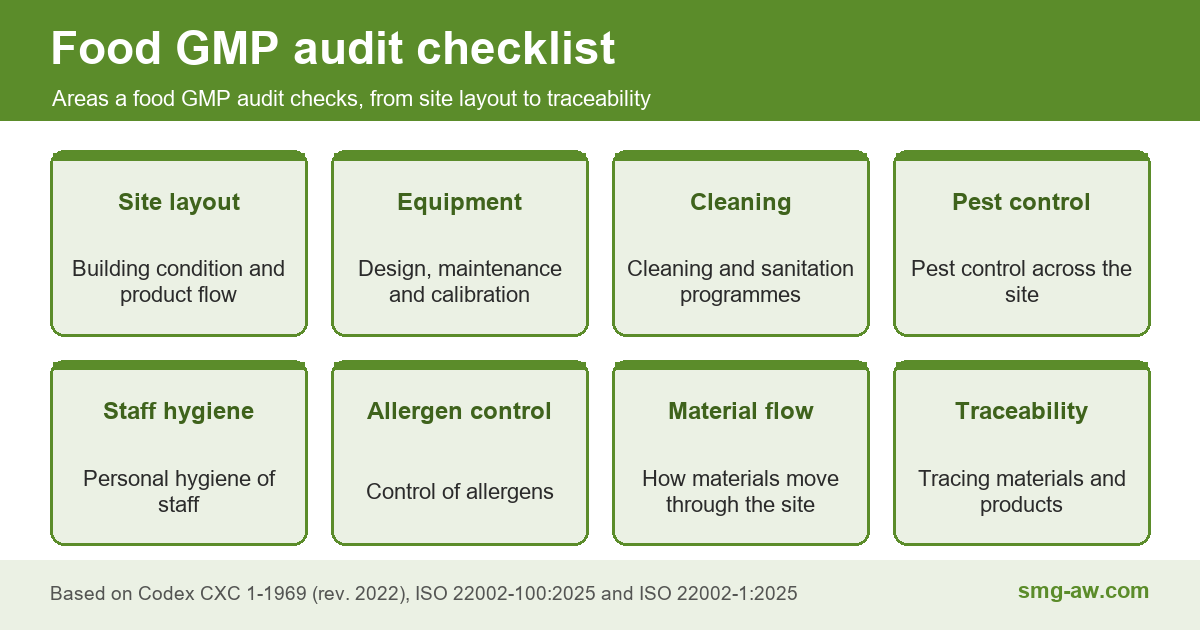
GMP (Good Manufacturing Practices) are the basic hygiene and operating conditions a food factory needs to produce safe food. They cover the building, equipment, cleaning, pest control, staff hygiene and how materials move through the site.
For food, GMP is not a single certifiable standard. The main references are the Codex General Principles of Food Hygiene (CXC 1-1969, revised 2022) and the prerequisite program standards ISO 22002-100:2025 and ISO 22002-1:2025. National food laws add their own rules. You show conformity with GMP through an audit, not a certificate.
Who needs a food GMP audit?
Any business that makes or packs food needs GMP in place, and an independent GMP audit is most useful before a buyer approval, a license inspection or a certification audit. Typical users are:
- Food and drink manufacturers of every size.
- Ingredient and additive producers.
- Contract packers and co-manufacturers.
- Small and new businesses preparing for HACCP or a GFSI scheme.
Buyers and importers in Canada, Saudi Arabia, Lebanon and the GCC often ask for a GMP audit before they approve a supplier. Food authorities also inspect GMP conditions when licensing a site.
What does a food GMP audit cover?
A food GMP audit checks the conditions across your whole site, from the building to staff hygiene and product flow. It covers:
- Site layout, building condition and product flow.
- Equipment design, maintenance and calibration.
- Cleaning and sanitation programs.
- Pest control.
- Personal hygiene, health checks and training.
- Water, air and utilities.
- Receiving, storage and control of materials.
- Allergen control and prevention of cross-contamination.
- Waste management.
- Product identification and traceability.
What are the benefits of a GMP audit?
A GMP audit gives you an independent view of your site’s hygiene before a customer or authority sees it. The main benefits are:
- Fewer rejected batches and less rework when hygiene controls work.
- A clear list of gaps to close before HACCP, ISO 22000 or FSSC 22000.
- Evidence for buyers that your site meets accepted good practice.
- An independent view of your site’s hygiene conditions before a customer or authority sees them.
How does GMP connect to other standards?
GMP is the foundation under HACCP. ISO 22002 sets GMP-type prerequisite programs in detail, and ISO 22000 and FSSC 22000 require them. GHP is the matching code for food service and retail. For cosmetics, GMP is covered by ISO 22716, which has its own page.
How can you show conformity to GMP?
You show conformity to food GMP through a compliance audit, not a certificate. SMG audits your site against Codex CXC 1-1969 and ISO 22002 and gives you a written report.
SMG offers:
- GMP compliance audit: an on-site audit against Codex CXC 1-1969 and ISO 22002 with a written report.
- Gap assessment: a readiness review before a buyer audit or certification.
- Second-party audits of your suppliers.
- Training for production and quality teams.
If you need a certificate, ISO 22000 and FSSC 22000 include GMP-type controls and can be certified.
GMP vs GHP vs HACCP
| GMP | GHP | HACCP | |
|---|---|---|---|
| Main use | Food manufacturing | Food service, retail and the whole chain | Any food business |
| Focus | Site-wide hygiene and operating conditions | Site-wide hygiene basics | Specific hazards at critical control points |
| Main reference | Codex CXC 1-1969 and ISO 22002 | Codex CXC 1-1969 Chapter One | Codex CXC 1-1969 Chapter Two |
| How conformity is shown | Compliance audit | Compliance audit | Compliance audit |
Frequently asked questions
Can I get GMP certification for my food factory?
Food GMP is a set of good practices drawn from Codex and ISO 22002, not one certifiable standard, so there is no GMP certificate under these texts. SMG audits your site against them and reports the results. If your customer needs a certificate, ISO 22000 or FSSC 22000 are the usual routes, and both include GMP-type prerequisite programs.
What is the difference between GMP and HACCP?
GMP covers the general hygiene and operating conditions of the whole site, such as cleaning, pest control and staff hygiene. HACCP targets specific hazards at critical points in your process. You need GMP in place before HACCP can work, because a HACCP plan assumes the basic conditions are already under control.
What is the difference between GMP and GHP?
The terms overlap. GMP is the term mostly used in food manufacturing, while GHP (good hygiene practices) is the Codex term used across the food chain and is common in food service and retail. Both rest on the same Codex text, CXC 1-1969, and an SMG audit can cover either.
How much does a food GMP audit cost?
The cost depends on the days on site, which follow from the size of your site, the number of production lines and shifts, and travel. A single small site needs less time than a multi-line factory. SMG sends a written quote once you share these details, and the report you receive lists each gap with clear evidence.
Is GMP mandatory for food businesses?
In most countries, yes. Food laws in Canada, Saudi Arabia, Lebanon and the GCC require hygienic premises and practices, even when they do not use the word GMP. The legal detail differs by country and sector, so check your national rules. An independent GMP audit shows how your site measures up before an inspector visits.
Does SMG audit cosmetic GMP?
Yes. Cosmetic GMP follows a different standard, ISO 22716, which sets good manufacturing practices for cosmetics. SMG certifies cosmetic sites to ISO 22716 and issues the SMG ISO 22716 Cosmetics GMP certificate, as explained on our cosmetics page. This food GMP page uses Codex CXC 1-1969 and ISO 22002 as its references, so ask us which audit fits if you make both food and cosmetic products on one site.
Related standards
- HACCP (Codex CXC 1-1969): Hazard control method that depends on GMP being in place.
- ISO 22002 series prerequisite programs: Detailed PRP requirements for food manufacturing (Part 1 and Part 100).
- GHP: Matching Codex good hygiene practices for food service and retail.
- ISO 22000: Certifiable system that requires GMP-type prerequisite programs.
- ISO 22716: Good manufacturing practices for cosmetics.