Last updated: 19 November 2026
ISO 50001 is the international standard that sets the requirements for an energy management system (EnMS). The current edition is ISO 50001:2018 with Amendment 1:2024, which added climate action changes to clauses 4.1 and 4.2. It is published by ISO through technical committee ISO/TC 301 Energy management and energy savings. Its purpose is to help an organization use energy more efficiently and show measurable improvement in energy performance against a baseline and energy performance indicators. It suits any organization where energy is a large cost or risk, such as factories, cement and steel plants, food processors, data centers, hospitals, hotels, malls and building portfolios. ISO 50001 can be certified. A certification body audits the EnMS in Stage 1 and Stage 2, makes a certification decision, runs annual surveillance audits and recertifies in year 3. SMG audits and certifies ISO 50001 energy management systems in Canada, Saudi Arabia, Lebanon and the GCC, and also offers gap assessments and training.
Key facts
- Standard
- ISO 50001 Energy management systems - Requirements with guidance for use
- Current edition
- ISO 50001:2018 + Amd 1:2024
- Type
- Certifiable management system standard
- Who it is for
- Organizations where energy is a significant cost or risk
- Certificate and audit cycle
- 3-year certificate: Stage 1, Stage 2, decision, annual surveillance, recertification in year 3
- Transition or revision status
- 2018 edition with Amd 1:2024 current. No transition in progress
- Related standards
- ISO 14001, ISO 14064-1, ISO 50006, ISO 50015, ISO 14005
- SMG service
- Certification, gap assessment and training
- Where SMG works
- North America: Canada, USA and Mexico. Middle East: Saudi Arabia, the GCC (UAE, Qatar, Kuwait, Bahrain, Oman), Lebanon and Türkiye. Europe: UK, Ireland, Belgium, Italy, Spain, Portugal, Austria and Switzerland. Africa: Egypt, Morocco, Tunisia, Algeria, Libya, Nigeria, Ghana, Côte d'Ivoire, Liberia, Congo (Kinshasa and Brazzaville), Kenya and South Africa. Asia: China, Japan, South Korea, Indonesia, Malaysia and Vietnam.
- Audit languages
- English, Spanish, French, Arabic, Mandarin, Cantonese, German and Italian. In other countries SMG works with qualified local auditors.
What is ISO 50001?
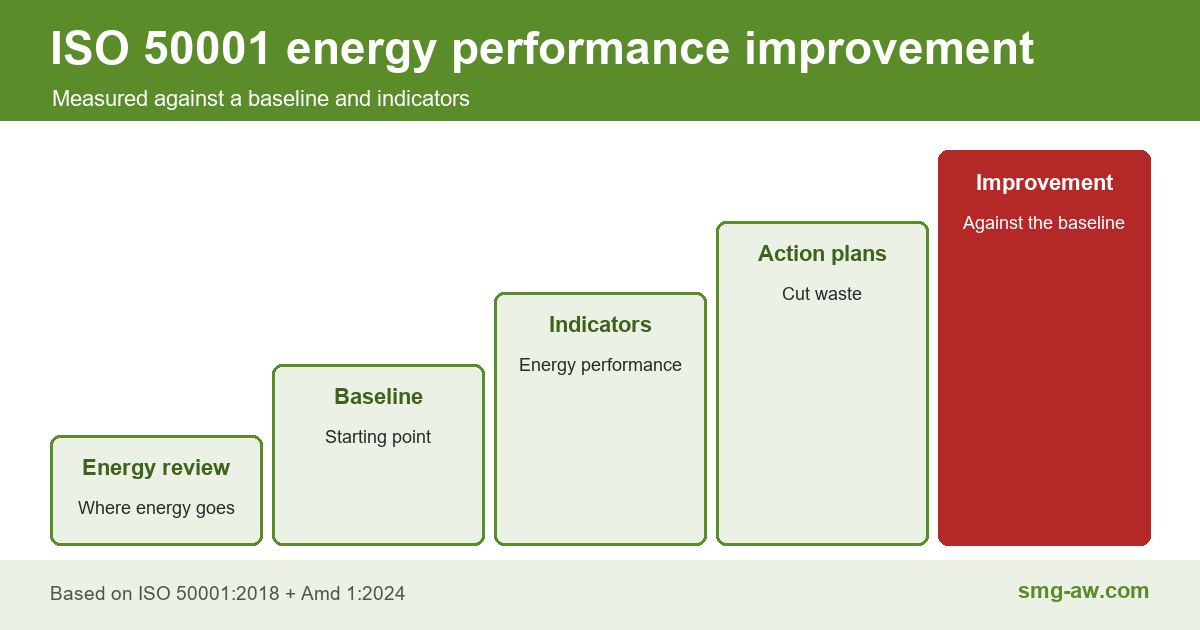
ISO 50001 is the international standard for energy management systems (EnMS). It sets the requirements for a system that helps you use energy more efficiently and improve your energy performance over time.
The current edition is ISO 50001:2018, published by ISO/TC 301 Energy management and energy savings and confirmed by ISO in 2024. Amendment 1:2024 added climate action changes: in clause 4.1 you must decide whether climate change is a relevant issue, and clause 4.2 notes that interested parties can have climate-related requirements. ISO 50001 is certifiable. It uses the same high-level structure as ISO 9001 and ISO 14001, so it fits into an integrated system.
Who needs ISO 50001 certification?
ISO 50001 suits any organization where energy is a significant cost or risk. Typical users are manufacturers, cement, steel and chemical plants, food processors, data centers, hospitals, hotels, malls, universities, water utilities and building portfolios.
Common triggers are rising energy costs, national efficiency programs and regulations, customer carbon targets, ESG reporting and the decarbonisation goals of investors and lenders.
What are the benefits of ISO 50001?
ISO 50001 helps you find where energy goes, cut waste and prove the improvement with data. The main benefits are:
- A clear energy review that shows where energy goes and which uses are significant.
- Energy performance indicators and a baseline, so you can measure real improvement.
- Lower energy costs through targeted action plans.
- Better data for greenhouse gas reporting and climate commitments.
- Energy considered in design and purchasing decisions.
- A system that integrates with ISO 14001 and ISO 9001 audits.
How does ISO 50001 connect to other standards?
ISO 50001 works closely with ISO 14001, which covers your wider environmental aspects. ISO 14064-1 covers greenhouse gas inventories, where energy data is a main input. ISO 50006 gives guidance on energy baselines and performance indicators. ISO 50015 covers measurement and verification of energy performance. ISO 14005 offers a phased route where energy is often an early step.
How does ISO 50001 certification work with SMG?
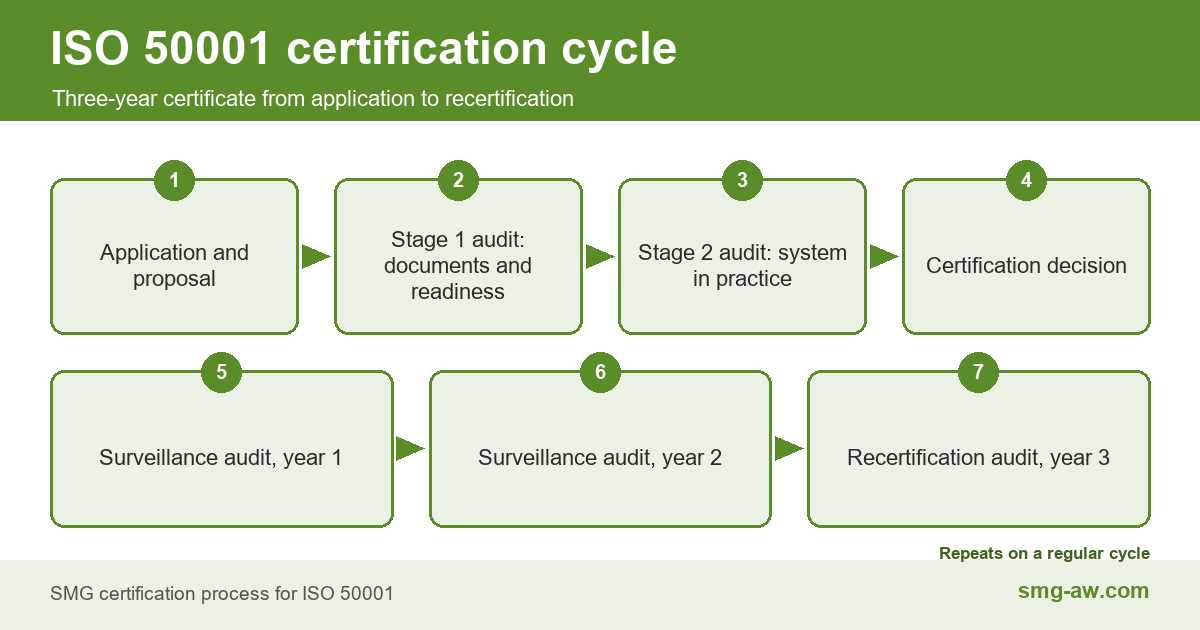
SMG certifies your EnMS through a three-year cycle of audits. SMG audits, certifies and trains.
- Application: you complete our questionnaire and receive a proposal based on your sites, energy use and scope.
- Stage 1 audit: we review your energy review, baseline, indicators and readiness.
- Stage 2 audit: we check that the EnMS works in practice and that you can show energy performance improvement.
- Certification decision: an SMG reviewer who did not take part in the audit decides.
- Surveillance: annual audits confirm the system is maintained and performance keeps improving.
- Recertification: a full audit in year 3 renews your certificate.
We also offer ISO 50001 gap assessments and training. We serve clients in Canada, Saudi Arabia, Lebanon and the GCC.
ISO 50001 vs ISO 14001
| Point | ISO 50001 | ISO 14001 |
|---|---|---|
| Focus | Energy performance | All environmental aspects |
| Key evidence | Energy review, baseline, energy performance indicators | Aspects and impacts, compliance obligations |
| Must show measured improvement? | Yes, improved energy performance | Improved environmental performance through the system |
| Can it be certified? | Yes | Yes |
| Shared structure | Yes, same high-level structure | Yes, same high-level structure |
Frequently asked questions
Is ISO 50001 certification mandatory?
No. ISO 50001 is voluntary in most countries. Some national energy efficiency programs, large energy user rules and incentive schemes accept or encourage ISO 50001 certification, and customers with carbon targets may ask for it. Check the energy regulations in your country, because they can set separate legal duties such as energy audits.
How long does ISO 50001 certification take?
It depends on your size and readiness. Before Stage 2 you need a completed energy review, a baseline, energy performance indicators, action plans, an internal audit and a management review. You also need enough data to show improvement. Once ready, Stage 1 and Stage 2 are usually a few weeks apart.
How much does ISO 50001 certification cost?
The cost depends on the number of people who affect energy performance, the number of sites, your annual energy use, the number of energy types and the number of significant energy uses. These factors set the audit days. SMG sends a fixed proposal for the full three-year cycle after you complete the application questionnaire.
What is special about an ISO 50001 audit?
Besides checking the system, the auditor looks for evidence that your energy performance has improved, using your baseline and energy performance indicators. A system that exists on paper but shows no improvement will not meet the standard. This is checked at the initial audit and again at recertification.
What changed with ISO 50001 Amendment 1:2024?
Amendment 1:2024 added climate action changes to clauses 4.1 and 4.2. You must decide whether climate change is a relevant issue for your EnMS and consider whether interested parties have climate-related requirements. Auditors check this as part of your context analysis. The rest of ISO 50001:2018 is unchanged.
What is the difference between ISO 50001 and ISO 14001?
ISO 14001 covers all your environmental aspects, such as waste, emissions and water. ISO 50001 focuses only on energy and requires you to show measured improvement in energy performance. Both share the same structure, so many organizations run them as one integrated system and SMG can audit them together.
Related standards
- ISO 14001: Environmental management system that often shares an integrated audit with ISO 50001.
- ISO 14005: Phased EMS route where energy is often an early phase.
- ISO 9001: Quality management system with the same high-level structure.
- ISO 46001: Water efficiency management system with the same structure, often audited together with ISO 50001