Last updated: 19 November 2026
The ISO/IEC 5259 series is a set of international standards on the quality of data used for analytics and machine learning. ISO and IEC published Parts 1 to 4 in 2024, Part 5 in 2025 and Part 6, a technical report, in 2026 through their joint AI committee, ISO/IEC JTC 1/SC 42. Part 1 gives terms and examples, Part 2 a data quality model and measures, Part 3 data quality management requirements and guidelines, Part 4 a process framework including data labeling, Part 5 a governance framework and Part 6 a visualization framework for data quality. The series is for data owners, data engineers, data scientists, AI product teams and the risk and audit staff who oversee them. Conformity with Part 3 is shown through an independent audit and written report. It supports the data controls in ISO/IEC 42001 Annex A. SMG offers ISO/IEC 5259 gap assessments, conformity assessments against Part 3 and training in Canada, Saudi Arabia, Lebanon and the GCC.
Key facts
- Standard
- ISO/IEC 5259 series Artificial intelligence - Data quality for analytics and machine learning (ML)
- Current edition
- Parts 1 to 4: 2024. Part 5: 2025. Part 6 (technical report): 2026
- Published by
- ISO and IEC (ISO/IEC JTC 1/SC 42)
- Type
- Multi-part standard: terminology, measures, requirements and guidelines, frameworks
- Who it is for
- Data, AI product, risk and audit teams
- Certificate and audit cycle
- No certificate: conformity shown by audit
- Transition or revision status
- All six parts current. Part 6 added in 2026. No revision announced
- Related standards
- ISO/IEC 42001, ISO/IEC 23053, ISO/IEC TR 24027, ISO 8000
- SMG service
- Gap assessment, conformity assessment against Part 3 and training
- Where SMG works
- North America: Canada, USA and Mexico. Middle East: Saudi Arabia, the GCC (UAE, Qatar, Kuwait, Bahrain, Oman), Lebanon and Türkiye. Europe: UK, Ireland, Belgium, Italy, Spain, Portugal, Austria and Switzerland. Africa: Egypt, Morocco, Tunisia, Algeria, Libya, Nigeria, Ghana, Côte d'Ivoire, Liberia, Congo (Kinshasa and Brazzaville), Kenya and South Africa. Asia: China, Japan, South Korea, Indonesia, Malaysia and Vietnam.
- Audit languages
- English, Spanish, French, Arabic, Mandarin, Cantonese, German and Italian. In other countries SMG works with qualified local auditors.
What is the ISO/IEC 5259 series?
The ISO/IEC 5259 series is a set of international standards on the quality of data used for analytics and machine learning. It tells you how to describe, measure, manage and govern data quality so that AI models are trained and run on data that is fit for purpose.
ISO and IEC published Parts 1 to 4 in 2024, Part 5 in 2025 and Part 6, a technical report, in 2026 through ISO/IEC JTC 1/SC 42.
What are the parts of ISO/IEC 5259?
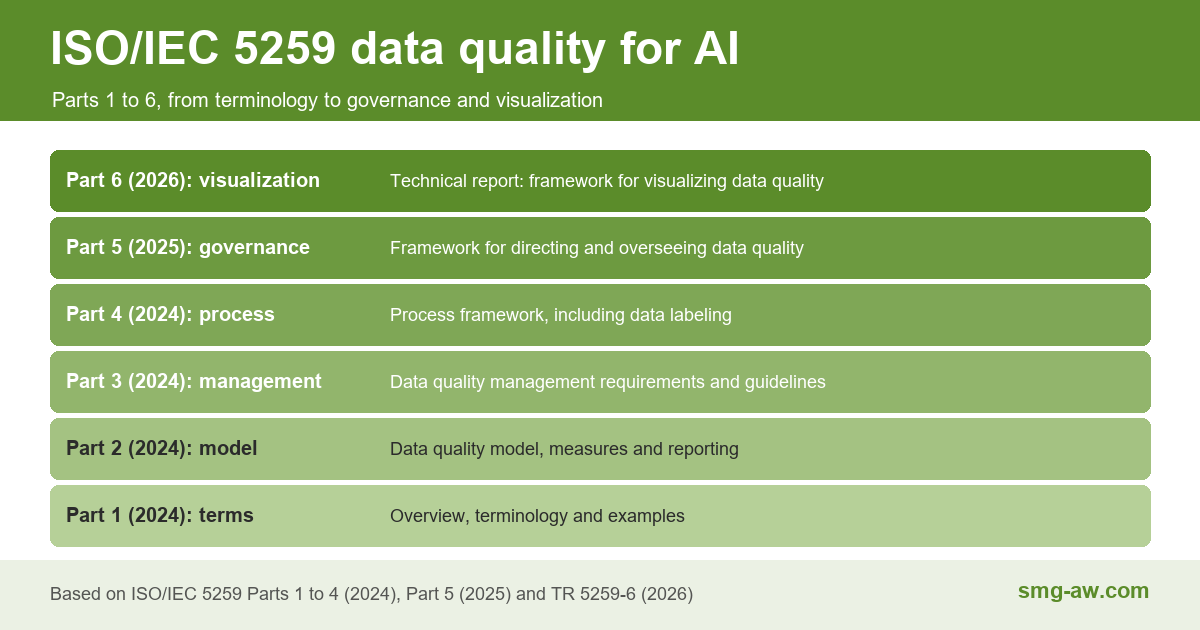
ISO/IEC 5259 has six parts. Parts 1 to 4 were published in 2024, Part 5 in 2025 and Part 6, a technical report, in 2026.
- Part 1 (2024): overview, terminology and examples.
- Part 2 (2024): a data quality model, measures and reporting.
- Part 3 (2024): data quality management requirements and guidelines across the data life cycle.
- Part 4 (2024): a process framework for data quality, including labeling for different types of machine learning.
- Part 5 (2025): a governance framework for directing and overseeing data quality.
- Part 6 (2026, technical report): a framework for visualizing data quality, so teams can see and explain data quality results.
Who needs ISO/IEC 5259?
The series is for data owners, data engineers, data scientists, AI product teams and the risk and audit staff who oversee them. It matters most when AI decisions depend on large, mixed or third-party datasets.
Typical triggers are poor model performance traced to data, a customer asking how training data is controlled, or the data controls in ISO/IEC 42001 Annex A.
What are the benefits of ISO/IEC 5259?
ISO/IEC 5259 gives you agreed measures and clear ownership for the data your AI depends on. The main benefits are:
- Agreed measures for data quality instead of opinions.
- Clear ownership of data quality across collection, preparation, labeling and use.
- Fewer model failures caused by missing, outdated or unbalanced data.
- Better evidence of data provenance for customers and regulators.
- A governance layer that links data quality to board-level oversight.
How does ISO/IEC 5259 connect to other standards?
ISO/IEC 5259 supports the data controls of ISO/IEC 42001 and the data stages described in ISO/IEC 23053. Poor data is a main cause of the bias covered by ISO/IEC TR 24027. The ISO 8000 series covers data quality more generally, outside AI.
How can you show conformity to ISO/IEC 5259?
Most of the series is guidance and terminology. Part 3 sets requirements and guidelines, and conformity with it is shown through an independent audit, not an SMG certificate. SMG offers:
- Gap assessment: we compare your data quality practice for selected AI systems with Parts 2 to 5.
- Conformity assessment: a structured audit of your data quality management against Part 3, with a written report.
- Training: an introduction to the series for data and AI teams.
If you want a certificate for AI governance, the certifiable route is ISO/IEC 42001.
Frequently asked questions
Is ISO/IEC 5259 certifiable?
No. The ISO/IEC 5259 series is not a management system standard, so there is no certificate for it. Most parts are terminology, measures and frameworks. Part 3 contains data quality management requirements and guidelines, so you can show conformity with it through an independent audit. SMG gives you an independent report you can show clients, boards and regulators. For a management system certificate on AI, the route is ISO/IEC 42001.
Which part of ISO/IEC 5259 should we start with?
Start with Part 1 for the terms and concepts and Part 2 for the data quality model and measures. Use Part 3 when you want to organize data quality management in a structured way, Part 4 for the process steps, including labeling, and Part 5 when the board needs a governance framework for data quality. Part 6 helps teams visualize and explain data quality results.
Does ISO/IEC 5259 apply only to machine learning?
No. The series covers data used for both analytics and machine learning. Its examples and the Part 4 process framework focus on machine learning, including how data is labeled for supervised, unsupervised and reinforcement learning, but the measures and management practices also suit analytics and reporting data.
How does ISO/IEC 5259 relate to ISO/IEC 42001?
ISO/IEC 42001 Annex A includes controls on data for AI systems, such as data quality, data provenance and data preparation. The ISO/IEC 5259 series gives the detail on how to define, measure and manage that quality, so it is a useful reference when you prepare for an ISO/IEC 42001 certification audit.
What does an ISO/IEC 5259 gap assessment depend on?
The effort depends on how many AI systems and datasets are in scope, how many data sources feed them and how much of your data quality practice is already written down. SMG agrees the scope and the parts of the series to use with you, then reports the gaps in writing.
Related standards
- ISO/IEC 42001: Certifiable AI management system with Annex A data controls.
- ISO/IEC 23053: Describes the ML pipeline stages where data quality applies.
- ISO/IEC TR 24027: Bias guidance, since poor data is a main source of bias.
- ISO/IEC 22989: Core AI terms used across the series.