Last updated: 19 November 2026
ISO/IEC 23053 is an international framework that describes the generic components and functions of an artificial intelligence system that uses machine learning. The current edition is ISO/IEC 23053:2022, published by ISO and IEC through their joint AI committee, ISO/IEC JTC 1/SC 42. An amendment on generative AI entered the final approval stage at ISO in August 2026. The framework explains the main ML approaches and the ML pipeline, from data acquisition and preparation through training, verification and validation to deployment and operation. It helps engineers, data scientists, architects, auditors and buyers describe and review ML systems in a common way. It is a framework document, so it cannot be certified and there is no audit against it. The certifiable route for AI governance is ISO/IEC 42001. SMG uses ISO/IEC 23053 in machine learning awareness training and as a reference in AI gap assessments, in Canada, Saudi Arabia, Lebanon and the GCC.
Key facts
- Standard
- ISO/IEC 23053 Framework for Artificial Intelligence (AI) Systems Using Machine Learning (ML)
- Current edition
- ISO/IEC 23053:2022 (first edition)
- Published by
- ISO and IEC (ISO/IEC JTC 1/SC 42)
- Type
- Framework (guidance)
- Who it is for
- Engineers, data scientists, architects, auditors and AI buyers
- Certificate and audit cycle
- No certificate: used as a reference in gap assessments
- Transition or revision status
- Amendment 1 (generative AI) in final approval stage at ISO since August 2026
- Related standards
- ISO/IEC 22989, ISO/IEC 5259 series, ISO/IEC 23894, ISO/IEC 42001
- SMG service
- Training and gap assessment
- Where SMG works
- North America: Canada, USA and Mexico. Middle East: Saudi Arabia, the GCC (UAE, Qatar, Kuwait, Bahrain, Oman), Lebanon and Türkiye. Europe: UK, Ireland, Belgium, Italy, Spain, Portugal, Austria and Switzerland. Africa: Egypt, Morocco, Tunisia, Algeria, Libya, Nigeria, Ghana, Côte d'Ivoire, Liberia, Congo (Kinshasa and Brazzaville), Kenya and South Africa. Asia: China, Japan, South Korea, Indonesia, Malaysia and Vietnam.
- Audit languages
- English, Spanish, French, Arabic, Mandarin, Cantonese, German and Italian. In other countries SMG works with qualified local auditors.
What is ISO/IEC 23053?
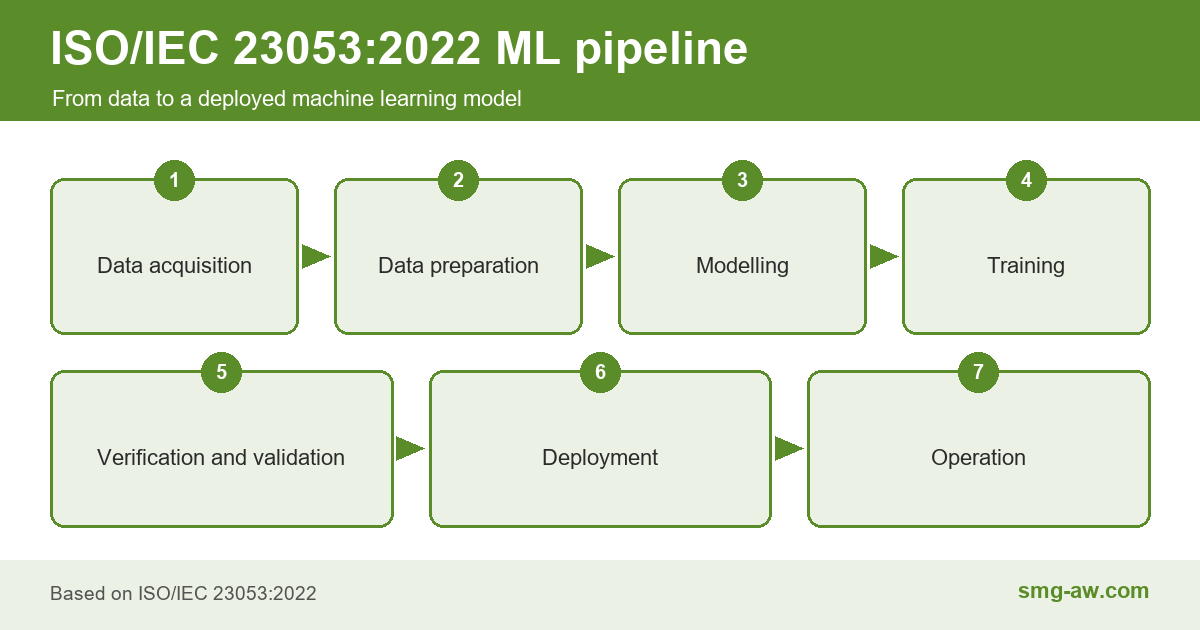
ISO/IEC 23053:2022 is an international framework that describes the generic parts and functions of an AI system that uses machine learning. It gives a common picture of how ML systems are built and run, and it is a framework document, so no organization is certified against it.
ISO and IEC published it in 2022 through ISO/IEC JTC 1/SC 42. An amendment that extends it to generative AI entered the final approval stage in August 2026.
Who needs ISO/IEC 23053?
It is useful for engineers, data scientists, solution architects, auditors and buyers who need to describe or review an ML system in a structured way. It also helps managers understand what sits behind an AI product.
Typical triggers are documenting an AI system for a customer, scoping an ISO/IEC 42001 audit or comparing AI suppliers.
What are the benefits of ISO/IEC 23053?
ISO/IEC 23053 gives technical and non-technical teams one shared picture of how an ML system is built. The main benefits are:
- A shared model of ML system parts, from data to deployed model.
- Clearer system documentation for customers, auditors and regulators.
- Easier scoping of risk and impact assessments, because each component is named.
- A consistent way to compare suppliers and their ML pipelines.
- Common ground between technical and non-technical teams.
What does ISO/IEC 23053 cover?
The document explains the main ML approaches, such as supervised, unsupervised, semi-supervised and reinforcement learning. It describes the ML pipeline: data acquisition and preparation, modeling, training, verification and validation, deployment and operation. It also covers the place of the model within the wider AI system, the tools and services around it, and the role of data throughout.
How does ISO/IEC 23053 connect to other standards?
ISO/IEC 23053 builds on the concepts in ISO/IEC 22989. The ISO/IEC 5259 series sets out data quality guidance for the data stages of the ML pipeline. ISO/IEC 23894 helps assess risk at each stage, and ISO/IEC 42001 brings it all into a certifiable AI management system.
How can you show conformity to ISO/IEC 23053?
ISO/IEC 23053 is a reference framework, so there is no certificate. SMG offers:
- Training: awareness sessions that explain ML system building blocks to managers, auditors and project teams.
- Gap assessment: as part of an AI governance review, we use the framework to check that your system documentation and life cycle controls cover each ML stage.
If you want a certificate, the certifiable route is ISO/IEC 42001.
Frequently asked questions
Can we be certified to ISO/IEC 23053?
No. ISO/IEC 23053:2022 is a descriptive framework with no requirements, so there is no certificate and no audit against it. You can use it as a reference to document your ML systems and to check that assessments cover every stage. Certification for AI governance is available against ISO/IEC 42001.
Does ISO/IEC 23053 cover generative AI and large language models?
Not specifically in the 2022 edition, which covers machine learning in general, and its component view already helps teams describe systems built on large models. ISO/IEC 23053:2022/Amd 1 adds generative AI specifically and entered the final approval stage at ISO in August 2026. Check the ISO catalog for its publication date.
What is the difference between ISO/IEC 23053 and ISO/IEC 22989?
ISO/IEC 22989 defines AI concepts and terms for all types of AI. ISO/IEC 23053 applies those terms to describe how a machine learning system is structured and how it works, from data to deployed model. Most teams read ISO/IEC 22989 first and then use ISO/IEC 23053 for system documentation.
Who in my team should read ISO/IEC 23053?
Architects and data scientists use it to document ML systems in a consistent way. Risk owners, compliance staff and auditors use it to make sure no stage of the ML pipeline is missed in risk and impact assessments. Buyers can use it to compare how suppliers describe their systems.
How is ISO/IEC 23053 used in an ISO/IEC 42001 gap assessment?
In an ISO/IEC 42001 gap assessment, the framework helps check that your AI system documentation and life cycle controls cover every ML stage, such as data preparation, training, validation and monitoring after deployment. Gaps in those stages often point to missing controls in Annex A of ISO/IEC 42001.
Related standards
- ISO/IEC 22989: The AI concepts and terms that ISO/IEC 23053 builds on.
- ISO/IEC 5259 series: Data quality guidance for the data stages of the ML pipeline.
- ISO/IEC 23894: Risk guidance to apply at each pipeline stage.
- ISO/IEC 42001: The certifiable AI management system.