Last updated: 19 November 2026
ISO/IEC 23894 is international guidance on managing the risks that come from developing, providing or using artificial intelligence. The current edition is ISO/IEC 23894:2023, published by ISO and IEC through their joint AI committee, ISO/IEC JTC 1/SC 42. It applies the principles, framework and process of ISO 31000:2018 to AI and adds AI-specific risk sources and a mapping of risk work to each stage of the AI system life cycle. It is written for risk managers, compliance teams, product owners and data science leads in any organization that builds, buys or deploys AI. ISO/IEC 23894 is guidance, so it cannot be certified. An organization shows that its AI risk process follows it through an independent gap assessment or audit report. It is often used to design the AI risk assessment that ISO/IEC 42001 clause 6.1 requires. SMG offers ISO/IEC 23894 gap assessments, supplier assessments and training in Canada, Saudi Arabia, Lebanon and the GCC.
Key facts
- Standard
- ISO/IEC 23894 Information technology - Artificial intelligence - Guidance on risk management
- Current edition
- ISO/IEC 23894:2023 (first edition)
- Published by
- ISO and IEC (ISO/IEC JTC 1/SC 42)
- Type
- Guidance standard
- Who it is for
- Organizations that build, buy or deploy AI, and their risk and compliance teams
- Certificate and audit cycle
- No certificate: conformity shown by audit
- Transition or revision status
- Current. No revision announced
- Related standards
- ISO 31000, ISO/IEC 42001, ISO/IEC 42005, ISO/IEC TR 24027
- SMG service
- Gap assessment, supplier assessment and training
- Where SMG works
- North America: Canada, USA and Mexico. Middle East: Saudi Arabia, the GCC (UAE, Qatar, Kuwait, Bahrain, Oman), Lebanon and Türkiye. Europe: UK, Ireland, Belgium, Italy, Spain, Portugal, Austria and Switzerland. Africa: Egypt, Morocco, Tunisia, Algeria, Libya, Nigeria, Ghana, Côte d'Ivoire, Liberia, Congo (Kinshasa and Brazzaville), Kenya and South Africa. Asia: China, Japan, South Korea, Indonesia, Malaysia and Vietnam.
- Audit languages
- English, Spanish, French, Arabic, Mandarin, Cantonese, German and Italian. In other countries SMG works with qualified local auditors.
What is ISO/IEC 23894?
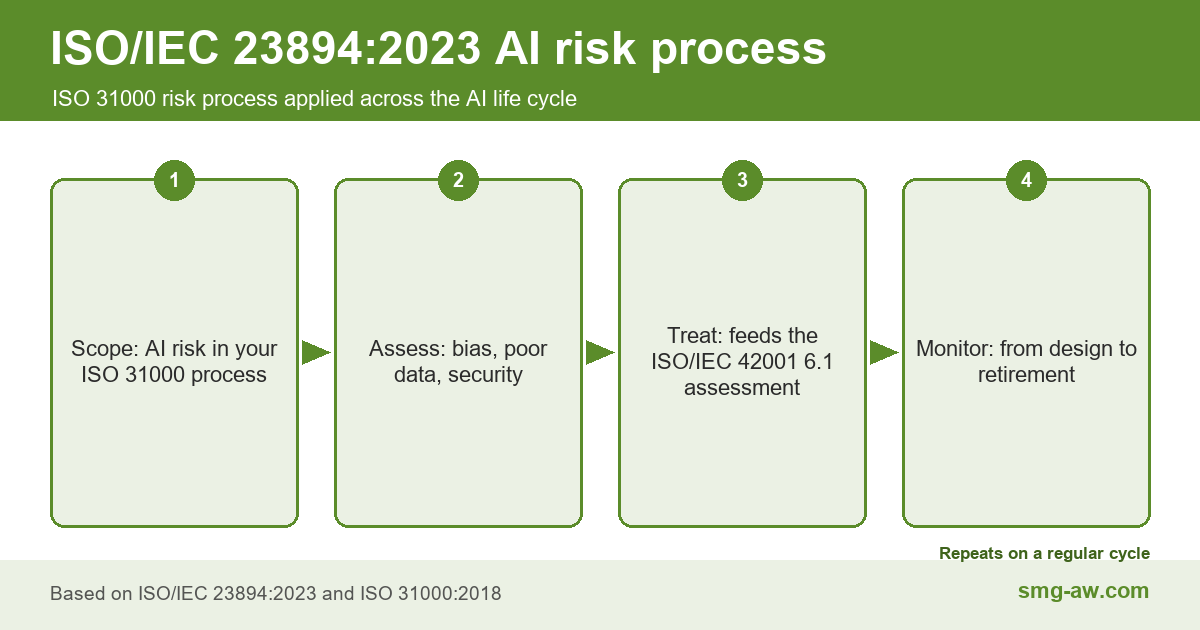
ISO/IEC 23894:2023 is international guidance on how to manage risks that come from developing, providing or using artificial intelligence. It adapts the principles and process of ISO 31000 to AI, and it is a guidance document, so no one is certified against it.
ISO and IEC published the first edition in February 2023 through the joint AI committee, ISO/IEC JTC 1/SC 42.
Who needs ISO/IEC 23894?
It suits any organization that builds, buys or deploys AI and wants a clear way to find and treat AI risks. Risk managers, compliance teams, product owners and data science leads use it most.
Common triggers include a new AI product launch, a board request for an AI risk register, a customer due diligence questionnaire or preparation for ISO/IEC 42001.
What are the benefits of ISO/IEC 23894?
ISO/IEC 23894 gives you one method to find, assess and treat AI risks inside the risk process you already run. The main benefits are:
- A shared method to identify AI risks such as bias, poor data, lack of transparency and security weaknesses.
- AI risk folded into your existing ISO 31000 based enterprise risk process instead of a separate list.
- Risk sources considered across the whole AI life cycle, from design to retirement.
- Better input to the risk assessment that ISO/IEC 42001 clause 6.1 requires.
- Clearer reporting to boards and customers.
What does ISO/IEC 23894 cover?
The document follows the structure of ISO 31000. It covers risk principles, the framework (leadership, integration, design and review) and the risk process (scope, assessment, treatment, monitoring and reporting). Its annexes describe AI-specific objectives and risk sources and map risk management to the stages of the AI system life cycle.
How does ISO/IEC 23894 connect to other standards?
ISO/IEC 23894 builds on ISO 31000:2018. It feeds the AI risk assessment in ISO/IEC 42001 and sits beside ISO/IEC 42005, which deals with impacts on people and society. ISO/IEC TR 24027 goes deeper on bias, and ISO/IEC TR 24028 on trustworthiness.
For AI in safety-related vehicle systems, ISO/PAS 8800:2024 gives road-vehicle guidance on AI safety.
How can you show conformity to ISO/IEC 23894?
ISO/IEC 23894 is guidance, so there is no certificate. You show that your AI risk process follows it through an independent audit. SMG offers:
- Gap assessment: we compare your AI risk process with the guidance and report the gaps.
- Conformity assessment of suppliers: we assess an AI supplier’s risk practices on your behalf.
- Training: awareness and practitioner courses on AI risk based on ISO/IEC 23894 and ISO 31000.
If you want a certificate, the certifiable route is an ISO/IEC 42001 AI management system.
ISO 31000 vs ISO/IEC 23894 vs ISO/IEC 42001
| Point | ISO 31000:2018 | ISO/IEC 23894:2023 | ISO/IEC 42001:2023 |
|---|---|---|---|
| Scope | Any risk, any organization | Risks from AI | Whole AI management system |
| Type | Guidelines | Guidance | Requirements |
| Certifiable | No | No | Yes |
| How conformity is shown | Gap assessment or audit | Gap assessment or audit | Certification audit cycle |
Frequently asked questions
Can my organization be certified to ISO/IEC 23894?
No. ISO/IEC 23894:2023 is guidance and contains no requirements to certify against. You can show that your AI risk process follows it through an independent gap assessment or audit report. If you need a certificate, the certifiable route is an AI management system under ISO/IEC 42001, where AI risk assessment is a requirement.
What is the difference between ISO/IEC 23894 and ISO 31000?
ISO 31000:2018 gives risk management principles for any type of risk. ISO/IEC 23894 applies those same principles, framework and process to AI. It adds AI-specific risk sources, such as lack of transparency and level of automation, and links risk work to each stage of the AI system life cycle.
Is ISO/IEC 23894 mandatory for ISO/IEC 42001?
No. ISO/IEC 42001 does not require you to use ISO/IEC 23894. It does require an AI risk assessment and risk treatment in clause 6.1, and many organizations use ISO/IEC 23894 to design that process. Auditors check that your process meets ISO/IEC 42001, whatever method you choose.
What AI risks does ISO/IEC 23894 cover?
It covers risk sources such as the complexity of the environment, lack of transparency and explainability, level of automation, machine learning issues, system hardware, life cycle problems and technology readiness. It also lists AI-related objectives, such as fairness, security, safety and privacy, that your risk assessment should protect.
How long does an ISO/IEC 23894 gap assessment take?
It depends on how many AI systems are in scope and how mature your risk process is. A gap assessment for one business unit and a few AI systems is usually short, with document review followed by interviews. SMG agrees the scope with you first and shows the days in a written quotation.
What is the difference between ISO/IEC 23894 and ISO/IEC 42005?
ISO/IEC 23894 looks at AI risk to your organization and its objectives. ISO/IEC 42005 looks at the impact of an AI system on individuals, groups and society. ISO/IEC 42001 asks for both, so most organizations use the two documents side by side.
Related standards
- ISO/IEC 42001: The certifiable AI management system that uses AI risk assessment.
- ISO 31000: The general risk management guidelines ISO/IEC 23894 builds on.
- ISO/IEC 42005: Impact assessment guidance that complements organizational risk assessment.
- ISO/IEC TR 24027: Detailed guidance on one key AI risk, unwanted bias.
- ISO/IEC TR 24028: Overview of trustworthiness threats and mitigations.
- NIST AI RMF: the US AI risk framework that maps to ISO/IEC 23894
- ISO/PAS 8800: AI safety guidance for road vehicles