Last updated: 19 November 2026
ISO/IEC 42005 is international guidance on how to assess the impact of an artificial intelligence system on individuals, groups and society across its life cycle. The current edition is ISO/IEC 42005:2025, the first edition, published in May 2025 by ISO and IEC through their joint AI committee, ISO/IEC JTC 1/SC 42. It explains when to carry out an assessment, who is responsible, how to set scope and thresholds, and what to record, such as intended uses, foreseeable misuse, data, models, affected people, benefits and harms. It suits organizations whose AI affects people in hiring, lending, insurance, health, education or public services. ISO/IEC 42005 is guidance, so it cannot be certified. Conformity is shown through an independent audit of your impact assessment practice. It gives the detail behind the impact assessment that ISO/IEC 42001 requires. SMG offers ISO/IEC 42005 gap assessments, AI supplier assessments and training in Canada, Saudi Arabia, Lebanon and the GCC.
Key facts
- Standard
- ISO/IEC 42005 Information technology - Artificial intelligence (AI) - AI system impact assessment
- Current edition
- ISO/IEC 42005:2025 (first edition, May 2025)
- Published by
- ISO and IEC (ISO/IEC JTC 1/SC 42)
- Type
- Guidance standard
- Who it is for
- Organizations whose AI systems can affect people
- Certificate and audit cycle
- No certificate: conformity shown by audit
- Transition or revision status
- Current. Earlier draft versions are superseded and should not be used
- Related standards
- ISO/IEC 42001, ISO/IEC 23894, ISO/IEC TR 24027, ISO/IEC 27701
- SMG service
- Gap assessment, supplier assessment and training
- Where SMG works
- North America: Canada, USA and Mexico. Middle East: Saudi Arabia, the GCC (UAE, Qatar, Kuwait, Bahrain, Oman), Lebanon and Türkiye. Europe: UK, Ireland, Belgium, Italy, Spain, Portugal, Austria and Switzerland. Africa: Egypt, Morocco, Tunisia, Algeria, Libya, Nigeria, Ghana, Côte d'Ivoire, Liberia, Congo (Kinshasa and Brazzaville), Kenya and South Africa. Asia: China, Japan, South Korea, Indonesia, Malaysia and Vietnam.
- Audit languages
- English, Spanish, French, Arabic, Mandarin, Cantonese, German and Italian. In other countries SMG works with qualified local auditors.
What is ISO/IEC 42005?
ISO/IEC 42005:2025 is international guidance on how to assess the impact of an AI system on individuals, groups and society across its life cycle. It is a guidance document, so no organization is certified against it.
ISO and IEC published the first edition in May 2025 through ISO/IEC JTC 1/SC 42. It is the published standard. Earlier draft versions should no longer be used.
Who needs ISO/IEC 42005?
It is for organizations that develop, provide or use AI systems that can affect people, for example in hiring, lending, insurance, health, education, public services and customer service.
Typical triggers are an ISO/IEC 42001 project, which requires AI system impact assessments, a customer asking for an impact assessment before buying, or a regulation that expects a fundamental rights or data protection impact assessment.
What are the benefits of ISO/IEC 42005?
ISO/IEC 42005 gives you a repeatable way to assess AI impacts and keep the records customers and regulators ask for. The main benefits are:
- A consistent, repeatable way to assess AI impacts instead of one-off reviews.
- Attention to people outside your organization, including those who never chose to use the system.
- Clear points in the life cycle to start, update and review an assessment.
- Records that show how you considered harms and benefits before release.
- Better input to AI risk management and to decisions about whether to deploy.
- Easier links with privacy impact assessments you may already run.
What does ISO/IEC 42005 cover?
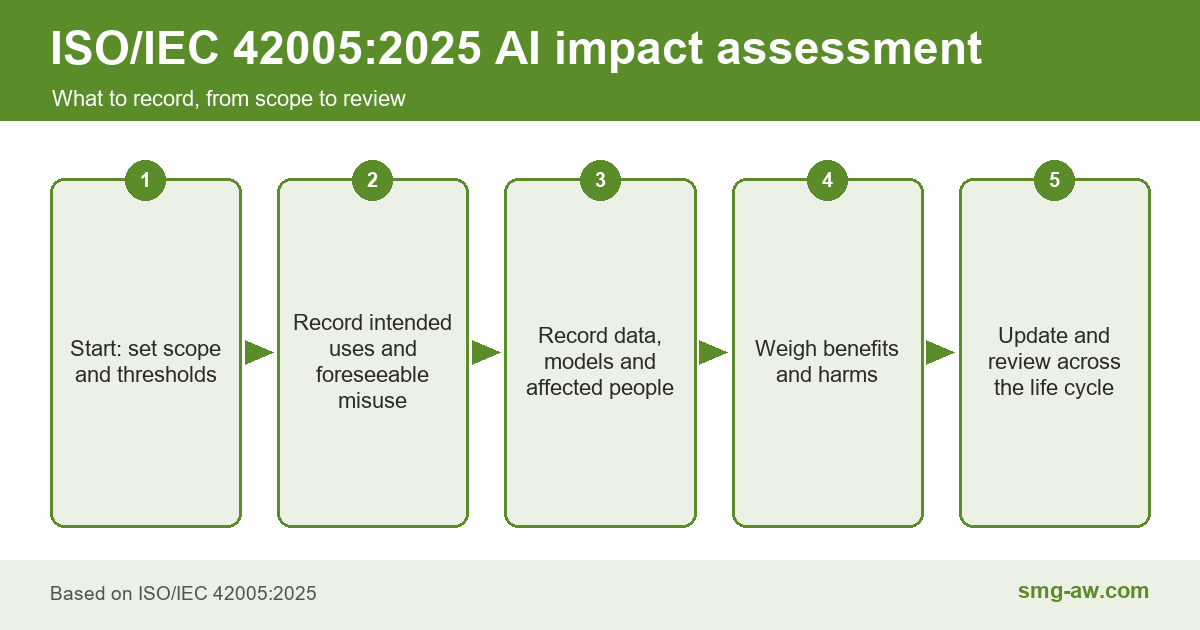
The guidance explains how to set up an impact assessment process: when to perform it, who is responsible, how to set scope and thresholds, and how to document, approve, monitor and review it. It then describes what an assessment should record, such as the system’s intended uses and foreseeable misuses, the data and its quality, the algorithms and models, the deployment environment, the people affected and the actual and reasonably foreseeable benefits and harms, with measures to address them.
How does ISO/IEC 42005 connect to other standards?
ISO/IEC 42001 requires an AI system impact assessment in clause 6.1.4 and related Annex A controls. ISO/IEC 42005 gives the detail on how to carry it out. ISO/IEC 23894 deals with risk to the organization, while ISO/IEC 42005 focuses on effects on people and society. Privacy impact assessment under ISO/IEC 29134 and ISO/IEC 27701 can run alongside it.
If your AI system is used in road vehicles, pair the impact assessment with the vehicle safety guidance in ISO/PAS 8800:2024.
How can you show conformity to ISO/IEC 42005?
ISO/IEC 42005 is guidance, so there is no certificate. You show that your impact assessments follow it through an independent audit. SMG offers:
- Gap assessment: we review your impact assessment procedure and a sample of completed assessments against the guidance.
- Conformity assessment of suppliers: we check whether an AI vendor has assessed the impacts of the system you plan to buy.
- Training: a practical course on planning and documenting AI system impact assessments.
If you want a certificate, the certifiable route is ISO/IEC 42001, where impact assessment is a requirement.
AI impact assessment (ISO/IEC 42005) vs AI risk assessment (ISO/IEC 23894)
| Point | ISO/IEC 42005:2025 | ISO/IEC 23894:2023 |
|---|---|---|
| Looks at | Effects on individuals, groups and society | Effects on the organization and its objectives |
| Supports ISO/IEC 42001 | AI system impact assessment | AI risk assessment and treatment |
| Type | Guidance | Guidance |
| Certifiable | No | No |
Frequently asked questions
Is ISO/IEC 42005 certifiable?
No. ISO/IEC 42005:2025 is guidance, so no organization can be certified against it. You can show that your impact assessments follow it through an independent gap assessment or audit. Certification is available for the AI management system under ISO/IEC 42001, where an AI system impact assessment is a requirement.
Which edition of ISO/IEC 42005 should we use?
Use ISO/IEC 42005:2025, the first published edition from May 2025. Draft versions that circulated in 2024 are superseded and may differ in structure and wording. If your procedures were written from a draft, compare them with the published text and update the references before your next audit.
What is the difference between an AI impact assessment and an AI risk assessment?
An AI risk assessment looks at effects on your organization and its objectives, and ISO/IEC 23894 gives guidance on it. An AI impact assessment looks at effects on individuals, groups and society, and ISO/IEC 42005 gives guidance on it. ISO/IEC 42001 requires both, and they should feed each other.
When should we carry out an AI system impact assessment?
Start early, during design, before the system is released. Update the assessment when the system, its intended use, its data or its deployment context changes, and review it during operation and monitoring. The guidance also recommends setting thresholds that tell you which systems need a full assessment.
Can an ISO/IEC 42005 assessment replace a data protection impact assessment?
Not on its own. An AI impact assessment can be coordinated with privacy and data protection impact assessments, and ISO/IEC 27701 helps with the privacy side. Legal requirements for data protection impact assessments still apply, so check what each law in your markets asks for.
What does an ISO/IEC 42005 gap assessment cover?
SMG reviews your impact assessment procedure, thresholds, roles and approval steps against the guidance. We then sample completed assessments to check that they record intended uses, affected people, data, models, benefits and harms, and the measures taken. You receive a written report listing the gaps found.
Related standards
- ISO/IEC 42001: The certifiable AI management system that requires impact assessment in clause 6.1.4.
- ISO/IEC 23894: Organizational AI risk guidance that complements impact assessment.
- ISO/IEC TR 24027: Methods for one key impact area, unwanted bias.
- ISO/IEC 27701: Privacy information management, where privacy impact assessment links in.
- ISO/IEC 38507: Board oversight of impact assessment results.
- ISO/PAS 8800: AI safety guidance for road vehicles