Last updated: 19 November 2026
ISO/IEC 42001 is the international requirements standard for an artificial intelligence management system (AIMS). The current edition is ISO/IEC 42001:2023, published in December 2023 by ISO and IEC through their joint AI committee, ISO/IEC JTC 1/SC 42. It sets out how an organization that develops, provides or uses AI writes an AI policy, assesses AI risks and impacts on people, controls the AI system life cycle and keeps improving. It suits software vendors, SaaS providers, banks, insurers, healthcare providers, employers and public bodies whose AI affects people or decisions. It uses the same Harmonized Structure as ISO 9001 and ISO/IEC 27001, with AI reference controls in Annex A. ISO/IEC 42001 is certifiable. The three-year cycle runs from application through a Stage 1 and Stage 2 audit and a certification decision, then surveillance in years 1 and 2 and recertification in year 3. SMG audits and certifies AI management systems against ISO/IEC 42001 and offers gap assessments and training in Canada, Saudi Arabia, Lebanon and the GCC.
Key facts
- Standard
- ISO/IEC 42001 Information technology - Artificial intelligence - Management system
- Current edition
- ISO/IEC 42001:2023 (first edition, December 2023)
- Type
- Certifiable management system standard
- Who it is for
- Any organization that develops, provides or uses AI systems
- Certificate and audit cycle
- Three-year certificate: Stage 1 and Stage 2, surveillance in years 1 and 2, recertification in year 3
- Transition or revision status
- Current. No new edition announced. Certification bodies follow ISO/IEC 42006:2025 when auditing it
- Related standards
- ISO/IEC 22989, ISO/IEC 23894, ISO/IEC 42005, ISO/IEC 27001
- SMG service
- Certification, gap assessment and training
- Where SMG works
- North America: Canada, USA and Mexico. Middle East: Saudi Arabia, the GCC (UAE, Qatar, Kuwait, Bahrain, Oman), Lebanon and Türkiye. Europe: UK, Ireland, Belgium, Italy, Spain, Portugal, Austria and Switzerland. Africa: Egypt, Morocco, Tunisia, Algeria, Libya, Nigeria, Ghana, Côte d'Ivoire, Liberia, Congo (Kinshasa and Brazzaville), Kenya and South Africa. Asia: China, Japan, South Korea, Indonesia, Malaysia and Vietnam.
- Audit languages
- English, Spanish, French, Arabic, Mandarin, Cantonese, German and Italian. In other countries SMG works with qualified local auditors.
What is ISO/IEC 42001?
ISO/IEC 42001:2023 is the international standard that sets requirements for an artificial intelligence management system (AIMS). It tells any organization that develops, provides or uses AI how to govern those systems responsibly, and it can be certified by an independent body.
ISO and IEC published the first edition in December 2023. It follows the same Harmonized Structure as ISO 9001 and ISO/IEC 27001, so clauses 4 to 10 will feel familiar if you already run a management system.
Who needs ISO/IEC 42001 certification?
You need ISO/IEC 42001 certification when customers, partners or regulators want independent evidence that your AI is governed. It fits any size and any sector.
Demand usually comes from three groups.
- AI builders: software vendors, model developers and platform providers who face AI questions in enterprise tenders.
- AI integrators: SaaS companies and service providers that embed third-party models. Your customer inherits your risk, so they ask for your evidence.
- AI users in sensitive decisions: banks, insurers, healthcare providers, employers and public bodies where AI affects a person, a payment or a safety outcome.
Typical triggers are customer questionnaires, procurement requirements and the arrival of AI regulation such as the EU AI Act.
What are the benefits of ISO/IEC 42001?
ISO/IEC 42001 gives you one auditable system for AI governance that buyers and regulators recognize. The main benefits are:
- One structured answer to the AI governance questions buyers now attach to security questionnaires.
- Clear accountability. Roles, AI policy and human oversight are written down and checked.
- Impact assessments for the AI systems in scope, so effects on people are considered before release.
- Data provenance and lifecycle controls from design to retirement.
- Shared audits with ISO/IEC 27001 or ISO 9001, because the core clauses match.
What does ISO/IEC 42001 require?
Beyond the common clauses, the AI-specific work sits in three places. Clause 6.1 asks for an AI risk assessment, risk treatment and an AI system impact assessment. Clause 8 covers operational control of those activities. Annex A lists 38 reference controls across AI policy, internal organization, resources, impact assessment, the AI system life cycle, data, information for interested parties, use of AI systems and third-party relationships.
How does ISO/IEC 42001 connect to other standards?
ISO/IEC 42001 uses the vocabulary of ISO/IEC 22989. ISO/IEC 23894 expands on AI risk management, and ISO/IEC 42005 gives detailed guidance on impact assessment. ISO/IEC 42006:2025 sets the extra rules that certification bodies follow when they audit ISO/IEC 42001. Many organizations certify ISO/IEC 42001 together with ISO/IEC 27001.
How does ISO/IEC 42001 certification work with SMG?
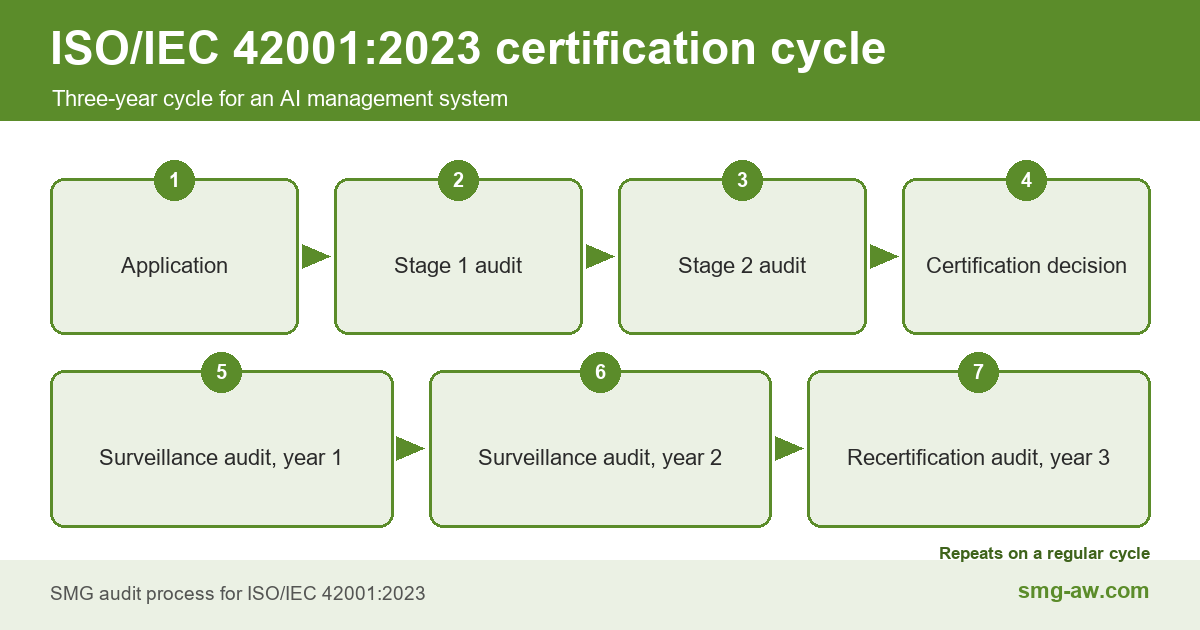
SMG certifies your AI management system through a three-year cycle: a two-stage initial audit, a certification decision, two surveillance audits and a recertification audit.
SMG is an international certification body. SMG audits, certifies and trains.
If a customer or regulator has asked for a specific type of certificate, tell us at the start so we can confirm what we can offer.
The certification cycle:
- Application and quotation based on your scope, sites, headcount and AI roles.
- Stage 1 audit: we review your AIMS documents, scope and readiness.
- Stage 2 audit: we test how the system works in practice, with interviews and records.
- Certification decision by an SMG reviewer who was not on the audit team.
- Surveillance audits in years 1 and 2.
- Recertification audit in year 3.
We also offer a gap assessment before Stage 1 and ISO/IEC 42001 awareness and internal auditor training.
ISO/IEC 42001 vs ISO/IEC 27001
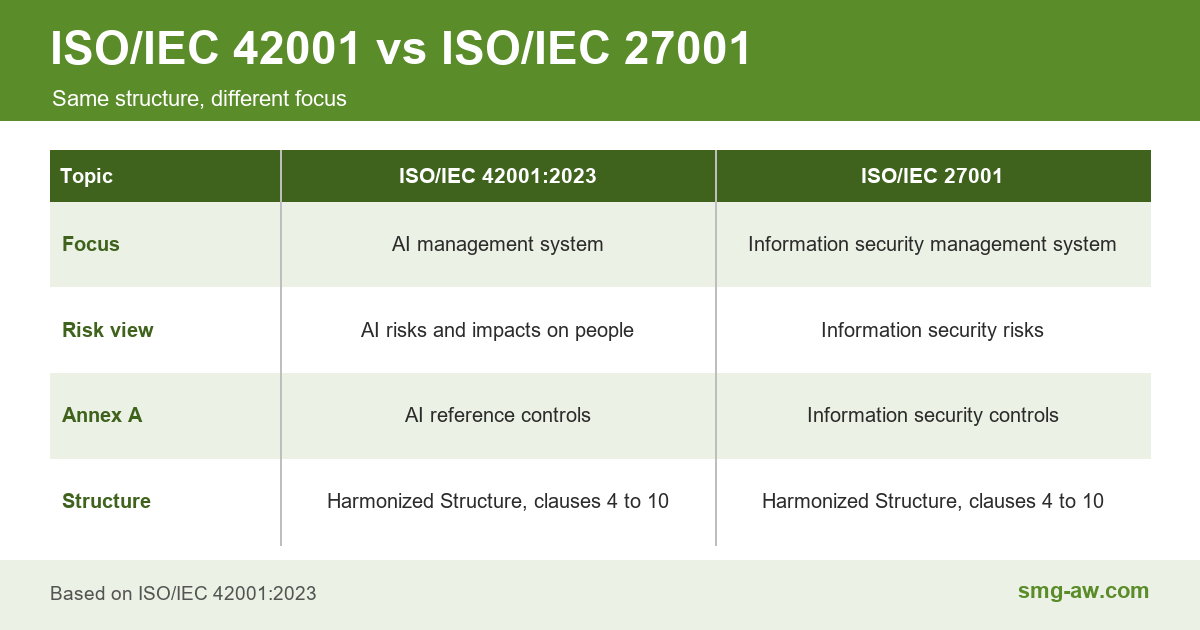
| Point | ISO/IEC 42001:2023 | ISO/IEC 27001:2022 |
|---|---|---|
| Focus | Responsible governance of AI systems | Security of information |
| Main risk view | AI risks to the organization plus impacts on people and society | Risks to confidentiality, integrity and availability |
| Annex A | AI reference controls (policy, data, life cycle, third parties) | 93 information security controls |
| Structure | Harmonized Structure, clauses 4 to 10 | Harmonized Structure, clauses 4 to 10 |
| Certifiable | Yes | Yes |
Frequently asked questions
Is ISO/IEC 42001 certification mandatory?
No. ISO/IEC 42001 certification is voluntary. No general law requires it, but customers ask for it more and more in tenders and supplier questionnaires. It also produces the records that AI rules such as the EU AI Act expect, like risk assessments, impact assessments and human oversight. A certificate does not replace legal compliance, so you still need to check each law that applies to you.
How long does ISO/IEC 42001 certification take?
It depends on how mature your AI governance already is. Before the Stage 2 audit your AIMS must be running, with records that include at least one internal audit and one management review. Stage 1 and Stage 2 are usually a few weeks apart so you can close any Stage 1 findings. Your SMG quotation shows the audit days for each stage.
What does the cost of ISO/IEC 42001 certification depend on?
The cost depends mainly on the number of audit days. Audit time is set by your headcount in scope, the number of sites, the AI roles you play, the number and complexity of your AI systems and whether you combine the audit with ISO/IEC 27001 or ISO 9001. SMG gives you a written quotation for the full three-year cycle after reviewing your application.
What is the difference between ISO/IEC 42001 and ISO/IEC 27001?
ISO/IEC 42001 covers how you govern AI systems, including impacts on people, data quality and the AI life cycle. ISO/IEC 27001 covers how you protect information. Both are certifiable and share clauses 4 to 10, so many organizations run them as one integrated system and have them audited together.
Which AI standards are certifiable and which are guidance?
ISO/IEC 42001 is the certifiable AI management system standard. Supporting documents such as ISO/IEC 23894 on AI risk, ISO/IEC 42005 on impact assessment, ISO/IEC 22989 on terms and the technical reports TR 24027 and TR 24028 are guidance. You use them to meet ISO/IEC 42001, but nobody is certified against them.
Can we combine ISO/IEC 42001 and ISO/IEC 27001 audits?
Yes. Both standards use the Harmonized Structure, so you can share policies, internal audits and management reviews. SMG can plan an integrated audit that covers both standards in one visit, which reduces duplication and disruption to your teams. The audit time is set for the combined scope and shown in your quotation.
Related standards
- ISO/IEC 27001: Information security certification that shares clauses 4 to 10 with ISO/IEC 42001.
- ISO/IEC 23894: AI risk management guidance that supports clause 6.1 of ISO/IEC 42001.
- ISO/IEC 42005: Detailed guidance for the AI system impact assessment required by ISO/IEC 42001 clause 6.1.4.
- ISO/IEC 22989: AI concepts and terms referenced by ISO/IEC 42001.
- ISO/IEC 5259 series: Data quality guidance that supports the Annex A data controls.
- ISO/IEC 38507: Board-level guidance on governing AI use.
- EN 18286: the AI quality management system standard cited under the EU AI Act
- EU AI Act: gap assessment against Regulation (EU) 2024/1689
- ISO/IEC 27090: security threats to AI systems