Last updated: 19 November 2026
ISO 29001 is the sector quality management system standard for organizations that supply products and services to the petroleum, petrochemical and natural gas industries. The current edition is ISO 29001:2020 with Amendment 1:2024, published by ISO and confirmed in 2025. It takes the full text of ISO 9001:2015 and adds sector requirements on risk, contingency planning, supplier control and product and service verification. Manufacturers and drilling, inspection, maintenance and logistics contractors use it to bid for work with operators and national oil companies in Saudi Arabia, the GCC and Canada. ISO 29001 is a certifiable requirements standard. The certificate lasts three years, with surveillance audits in years one and two and recertification in year three. It replaced ISO/TS 29001:2010, and the 2024 amendment added the climate change requirement to clauses 4.1 and 4.2. SMG offers ISO 29001 certification, gap assessment and training, and can combine the audit with ISO 9001, ISO 14001 and ISO 45001.
Key facts
- Standard
- ISO 29001 Petroleum, petrochemical and natural gas industries: sector quality management systems
- Current edition
- ISO 29001:2020 + Amd 1:2024 (confirmed 2025)
- Published by
- ISO
- Type
- Certifiable management system standard (sector QMS built on ISO 9001:2015)
- Who it is for
- Suppliers of products and services to oil, gas and petrochemical operators
- Certificate and audit cycle
- Three-year certificate: Stage 1 and Stage 2, annual surveillance in years one and two, recertification in year three
- Transition or revision status
- Current. Confirmed in 2025, no revision published
- SMG service
- Certification, gap assessment and training
- Where SMG works
- North America: Canada, USA and Mexico. Middle East: Saudi Arabia, the GCC (UAE, Qatar, Kuwait, Bahrain, Oman), Lebanon and Türkiye. Europe: UK, Ireland, Belgium, Italy, Spain, Portugal, Austria and Switzerland. Africa: Egypt, Morocco, Tunisia, Algeria, Libya, Nigeria, Ghana, Côte d'Ivoire, Liberia, Congo (Kinshasa and Brazzaville), Kenya and South Africa. Asia: China, Japan, South Korea, Indonesia, Malaysia and Vietnam.
- Audit languages
- English, Spanish, French, Arabic, Mandarin, Cantonese, German and Italian. In other countries SMG works with qualified local auditors.
What is ISO 29001?
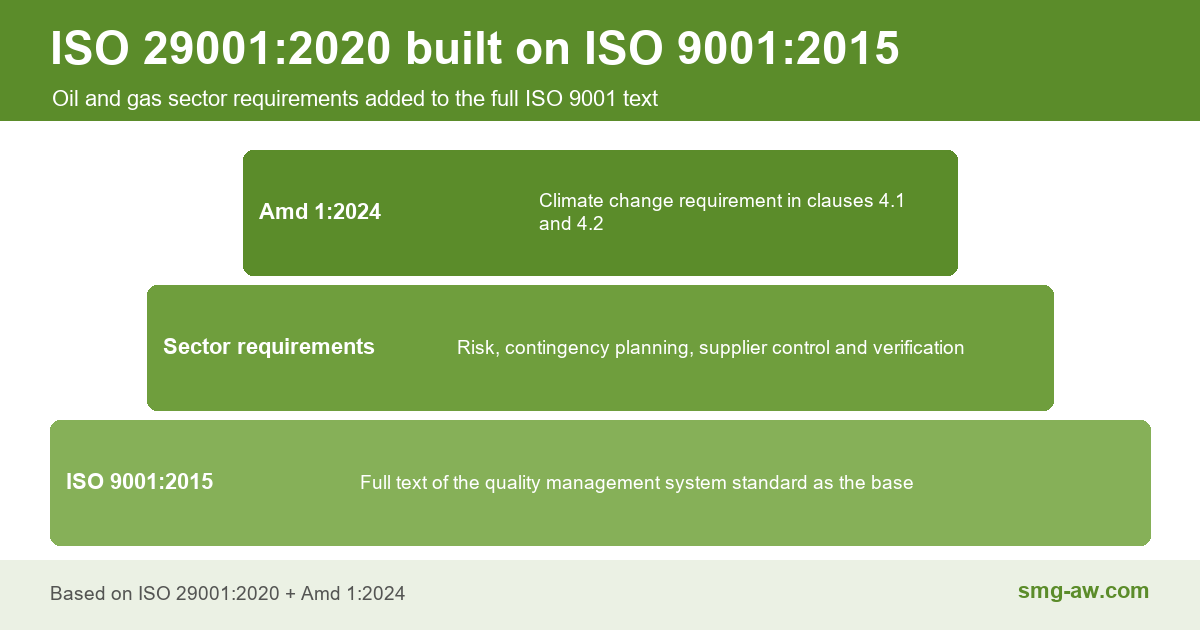
ISO 29001 is the quality management system standard for organizations that supply products and services to the petroleum, petrochemical and natural gas industries. It takes ISO 9001:2015 as its base and adds sector requirements on risk, supply chain control, contingency planning and product and service quality.
The current edition is ISO 29001:2020 with Amendment 1:2024, published by ISO and last confirmed in 2025. It replaced ISO/TS 29001:2010. The 2024 amendment means you must decide whether climate change is a relevant issue for your quality management system. ISO 29001 is a certifiable requirements standard.
Who needs ISO 29001 certification?
ISO 29001 certification is for organizations that supply products or services to the petroleum, petrochemical and natural gas industries, especially when operators or tenders ask for a sector quality system. Typical applicants are:
- Manufacturers of equipment, materials and components for upstream, midstream and downstream operations
- Service companies such as drilling, inspection, maintenance, testing and logistics contractors
- Suppliers bidding for contracts with national oil companies and operators in Saudi Arabia and the GCC
- Canadian suppliers to the energy sector who want a recognized sector QMS
- Organizations already certified to ISO 9001 that need to show sector-level control
What are the benefits of ISO 29001?
ISO 29001 gives you one quality system that oil and gas buyers recognize, with tighter control of risk and suppliers than ISO 9001 alone. The main benefits are:
- One sector-recognized quality system instead of several customer-specific ones
- Stronger control of risk in design, production and service delivery
- Clear rules for controlling your own suppliers and outsourced work
- Contingency planning for disruption, which buyers in this sector expect
- Evidence of quality performance that you can present in tenders
How does ISO 29001 connect to other standards?
ISO 29001 includes the full text of ISO 9001:2015, so an ISO 9001 system is the starting point. ISO 14001 and ISO 45001 cover environmental and health and safety risks that operators in this sector also review. ISO/IEC 27001 protects operational and engineering data. ISO 22301 covers business continuity when supply is disrupted.
How does ISO 29001 certification work with SMG?
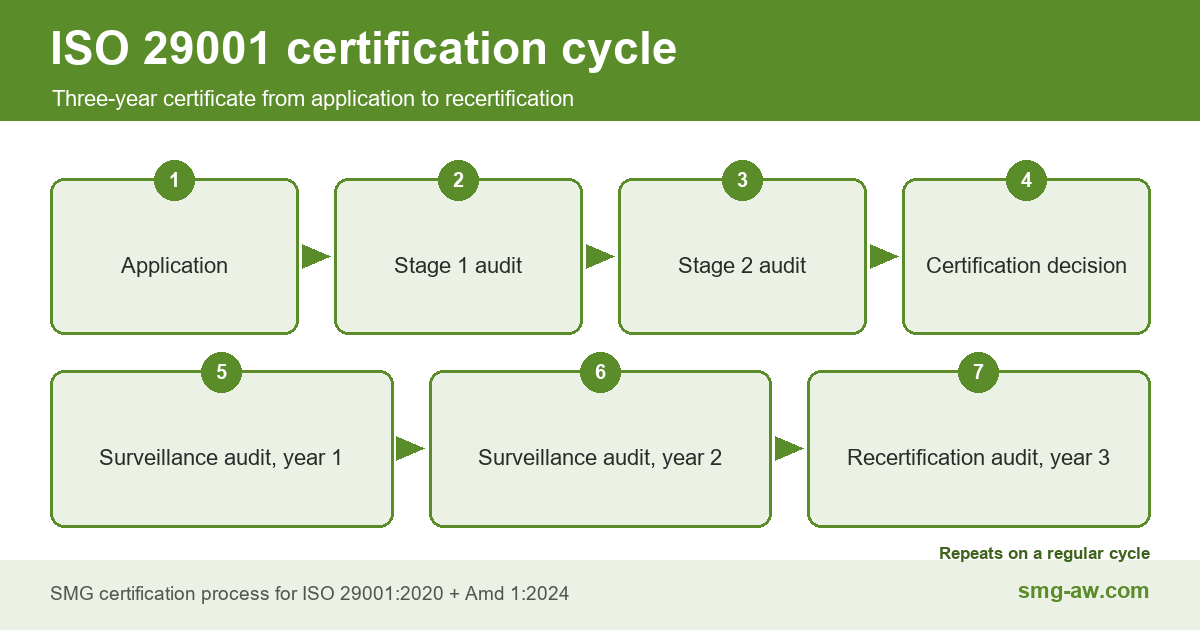
SMG offers certification to ISO 29001:2020, plus gap assessment and training. The certification cycle runs as follows:
- Application and quotation, based on your scope, sites and number of staff
- Stage 1 audit: we review your documented system and readiness
- Stage 2 audit: we audit how the system works in practice, on site or remotely where allowed
- Certification decision by an SMG reviewer who did not audit you
- Surveillance audits in the first and second years
- Recertification audit in the third year
If you are already certified to ISO 9001, the audits can be combined to save time.
ISO 29001 vs ISO 9001
| Point | ISO 29001:2020 | ISO 9001:2026 |
|---|---|---|
| Sector | Oil, gas and petrochemical supply chain | Any sector |
| Base text | All of ISO 9001:2015 plus sector requirements | Its own requirements |
| Extra focus | Risk, contingency planning, supplier control, product and service verification | General quality management |
| Who asks for it | Operators and national oil companies in tenders | Customers in every sector |
| Certificate | Yes, three-year cycle | Yes, three-year cycle |
Frequently asked questions
What is the difference between ISO 29001 and ISO 9001?
ISO 29001:2020 contains all of ISO 9001:2015 plus extra requirements for the oil and gas supply chain. These cover risk assessment, contingency planning, supplier control and product and service verification. ISO 9001 suits any sector, while ISO 29001 shows buyers in oil, gas and petrochemicals that your quality system meets their sector expectations.
Is ISO/TS 29001 still valid?
No. The technical specification ISO/TS 29001:2010 was replaced by the full international standard ISO 29001:2020. Certificates are now issued against ISO 29001:2020 with Amendment 1:2024. If a tender still names ISO/TS 29001, ask the buyer to confirm that the current edition meets the requirement before you apply.
Do I need ISO 9001 certification before ISO 29001?
No. You do not need a separate ISO 9001 certificate, because ISO 29001 already includes the ISO 9001 requirements. Many suppliers still hold both, because some customers ask for ISO 9001 by name. When you hold both, SMG can plan one combined audit so your team is not audited twice on the same clauses.
How long does ISO 29001 certification take?
It depends on your size, number of sites and how ready your system is. The audit runs in two stages. Stage 1 checks your documented system and readiness, and Stage 2 checks how it works in practice. The time between the two stages depends on what Stage 1 finds and how quickly you close any gaps.
How much does ISO 29001 certification cost?
It depends on the number of audit days, which are set by your headcount, number of sites, scope and the complexity of your products and services. Travel to remote sites also counts. Combining ISO 29001 with ISO 14001 or ISO 45001 in one integrated audit can reduce total days. Ask SMG for a quotation based on your scope.
Does ISO 29001 include the climate change amendment?
Yes. Amendment 1 of 2024 added a requirement in clause 4.1 to decide whether climate change is a relevant issue for your quality management system. It also added a note in clause 4.2 that interested parties can have climate-related requirements. Auditors check that you made this decision and can explain it.