Last updated: 19 November 2026
ISO/IEC 27001 is the international standard that sets the requirements for an information security management system (ISMS). The current edition is ISO/IEC 27001:2022 + Amd 1:2024, published by ISO and IEC. It shows how an organization finds its information risks, chooses controls to treat them and keeps those controls working, with 93 reference controls in Annex A that ISO/IEC 27002:2022 explains. The 2024 amendment asks you to consider climate change in clauses 4.1 and 4.2. It suits any organization that holds information worth protecting, including software and cloud providers, banks, fintechs, telecoms, health services and government suppliers. ISO/IEC 27001 is certifiable. Certification follows a three-year cycle: application, Stage 1 and Stage 2 audits, an independent certification decision, annual surveillance audits and recertification in year 3. SMG audits and certifies to ISO/IEC 27001:2022 + Amd 1:2024 under ISO/IEC 17021-1 and ISO/IEC 27006-1 for clients in Canada, Saudi Arabia, Lebanon and the GCC, and also offers gap assessments and training.
Key facts
- Standard
- ISO/IEC 27001 Information security management systems: Requirements
- Current edition
- ISO/IEC 27001:2022 + Amd 1:2024
- Published by
- ISO and IEC
- Type
- Certifiable management system standard
- Who it is for
- Any organization that holds information worth protecting
- Certificate and audit cycle
- Application, Stage 1, Stage 2, certification decision, annual surveillance, recertification in year 3 (certificate valid 3 years)
- Transition or revision status
- Transition from the 2013 edition has ended. Amd 1:2024 adds climate change to clauses 4.1 and 4.2.
- Related standards
- ISO/IEC 27002, ISO/IEC 27005, ISO/IEC 27017, ISO/IEC 27018, ISO/IEC 27701, ISO 22301
- SMG service
- Certification, gap assessment, training
- Where SMG works
- North America: Canada, USA and Mexico. Middle East: Saudi Arabia, the GCC (UAE, Qatar, Kuwait, Bahrain, Oman), Lebanon and Türkiye. Europe: UK, Ireland, Belgium, Italy, Spain, Portugal, Austria and Switzerland. Africa: Egypt, Morocco, Tunisia, Algeria, Libya, Nigeria, Ghana, Côte d'Ivoire, Liberia, Congo (Kinshasa and Brazzaville), Kenya and South Africa. Asia: China, Japan, South Korea, Indonesia, Malaysia and Vietnam.
- Audit languages
- English, Spanish, French, Arabic, Mandarin, Cantonese, German and Italian. In other countries SMG works with qualified local auditors.
What is ISO/IEC 27001?
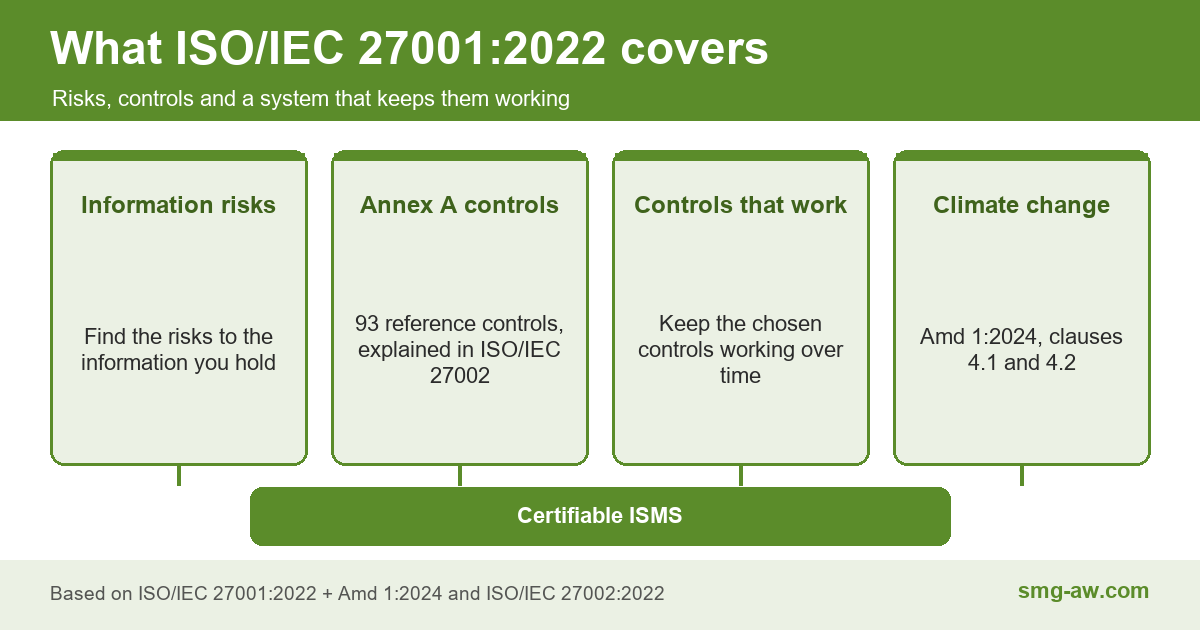
ISO/IEC 27001 is the international standard that sets the requirements for an information security management system (ISMS). It shows how an organization finds its information risks, chooses controls to treat them, and keeps those controls working over time.
The current edition is ISO/IEC 27001:2022, published by ISO and IEC, with Amendment 1:2024. The amendment asks you to decide whether climate change is a relevant issue (clause 4.1) and notes that interested parties can have climate-related requirements (clause 4.2). ISO/IEC 27001 is certifiable. Its Annex A lists 93 controls, which ISO/IEC 27002:2022 explains in detail.
Who needs ISO/IEC 27001 certification?
Any organization that holds information worth protecting can use ISO/IEC 27001. That includes software and cloud providers, banks and fintechs, telecoms, health services, government suppliers, outsourcing firms and manufacturers with sensitive designs.
Typical triggers are a tender that asks for a certificate, a large customer’s supplier questionnaire, a regulator’s expectations, or a board that wants independent assurance after an incident.
What are the benefits of ISO/IEC 27001 certification?
ISO/IEC 27001 certification gives customers and regulators independent evidence that you manage information risk in a planned way. Inside the business, it ties security spending to the risks that matter most.
- An independent certificate you can show in tenders and supplier reviews, which can shorten security questionnaires.
- A clear risk assessment that ties spending to the risks that matter most to you.
- Defined roles, so people know who owns each control and each incident.
- Regular internal audits and management reviews that catch weak points early.
- One framework that other standards, such as ISO/IEC 27701 for privacy, can build on.
How does ISO/IEC 27001 connect to other standards?
ISO/IEC 27002 gives guidance on each Annex A control. ISO/IEC 27005 explains how to run the risk process. ISO/IEC 27017 and ISO/IEC 27018 add cloud and cloud privacy guidance. ISO/IEC 27701:2025 sets requirements for privacy management. ISO 22301 covers business continuity, and ISO/IEC 20000-1 covers IT service management.
How does ISO/IEC 27001 certification work with SMG?
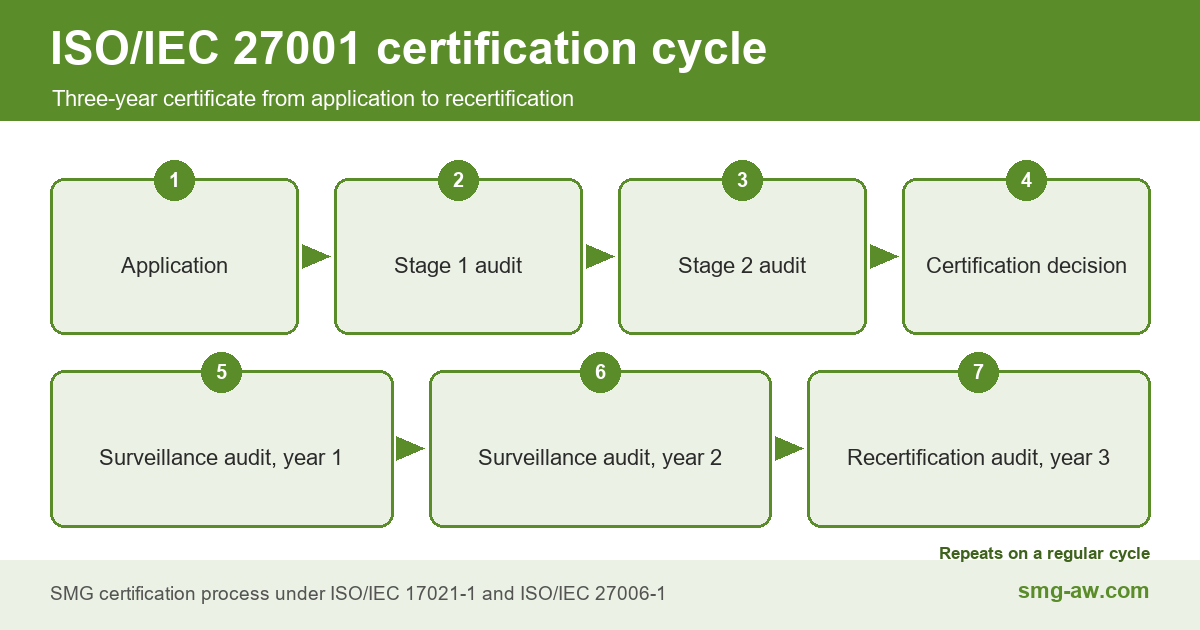
SMG provides ISO/IEC 27001:2022 + Amd 1:2024 certification. Our audits follow ISO/IEC 17021-1 and ISO/IEC 27006-1, the international rules for bodies that audit and certify an ISMS. We serve clients in Canada, Saudi Arabia, Lebanon and the GCC.
The certification cycle has six steps:
- Application: you tell us your scope, sites and headcount, and we send a quote with the audit days.
- Stage 1: we review your ISMS documents, risk assessment and Statement of Applicability, and confirm you are ready.
- Stage 2: we audit how the ISMS works in practice, interview staff and sample records.
- Certification decision: a reviewer who did not audit you makes the decision. Your certificate is valid for three years.
- Surveillance: we audit part of the system each year to confirm it still works.
- Recertification: in year 3 we run a full audit to renew the certificate.
We can also run a gap assessment before Stage 1 and offer ISO/IEC 27001 training. SMG audits, certifies and trains. If you already hold a certificate from another body, you can ask about transferring it to SMG.
ISO/IEC 27001 vs SOC 2 vs PCI DSS
| Point | ISO/IEC 27001 | SOC 2 | PCI DSS |
|---|---|---|---|
| What it is | International management system standard | AICPA attestation report on controls | Card industry security standard |
| Outcome | Certificate valid for three years | SOC 2 Type 1 or Type 2 report | Report on Compliance (ROC) and Attestation of Compliance (AOC) |
| Scope | Any information you choose to protect | Systems that serve your customers | Cardholder data only |
| How SMG helps | SMG audits and certifies your ISMS | SMG takes you from a readiness assessment to your SOC 2 report | SMG takes you from a gap assessment to your Report on Compliance and AOC |
Frequently asked questions
Which edition of ISO/IEC 27001 is current?
ISO/IEC 27001:2022 is current, together with Amendment 1:2024 on climate action. The amendment asks you to decide whether climate change is a relevant issue and notes that interested parties can have climate-related requirements. The transition from the 2013 edition has ended, so certificates to the 2013 edition are no longer valid.
How long does ISO/IEC 27001 certification take?
It depends on your size, scope and readiness. Many organizations need several months to run the ISMS, complete a risk assessment, an internal audit and a management review before Stage 2. The audits themselves take a few days in total for a small organization. We confirm audit days in our quote.
How much does ISO/IEC 27001 certification cost?
The cost depends mainly on the number of audit days, which follow your headcount, number of sites, scope and the complexity of your IT. Audit days are set by the international rules for ISMS certification bodies, not by guesswork. SMG sends a written quote with the days for each audit in the three-year cycle after a short application.
Is ISO/IEC 27001 certification mandatory?
ISO/IEC 27001 is voluntary in most countries. In practice it is often required by tenders, large customers, banks and government buyers, and some regulators expect a similar level of control. Certification gives you one independent certificate you can show to all of them instead of answering many separate security questionnaires.
Does ISO/IEC 27001 cover privacy laws such as GDPR?
It helps, because it requires you to identify legal requirements and protect personal data as an information asset. It does not by itself prove compliance with any privacy law, such as the GDPR, PIPEDA or Saudi Arabia’s PDPL. ISO/IEC 27701:2025 deals with privacy management in more depth and can run alongside your ISMS.
What is the difference between ISO/IEC 27001 and SOC 2?
ISO/IEC 27001 is an international standard that leads to a certificate for your management system. SOC 2 is an attestation report on controls under AICPA rules, and SMG takes you from a readiness assessment to your SOC 2 report. They share many control topics, so ISMS evidence can be reused, but one does not replace the other. CMMC also has its own separate assessments.
Related standards
- ISO/IEC 27005: guidance on the information security risk process required by clauses 6.1.2 and 8.2
- ISO/IEC 27017: cloud security controls that extend the ISO/IEC 27002 controls for cloud providers and users
- ISO/IEC 27018: protection of personal data held by public cloud processors
- ISO/IEC 27701: privacy information management, often audited alongside your ISMS
- ISO 22301: business continuity, which links to the ISO/IEC 27001 controls on ICT readiness
- ISO/IEC 27002: the control guidance behind Annex A
- NCA ECC: Saudi Essential Cybersecurity Controls
- NIS2: EU cybersecurity directive for essential and important entities