Last updated: 19 November 2026
ISO/IEC 20000-1 is the international standard for a service management system (SMS), the way an organization plans, delivers, monitors and improves the services it provides to customers. The current edition is ISO/IEC 20000-1:2018 + Amd 1:2024, published by ISO and IEC. The 2024 amendment adds climate change to the context clauses 4.1 and 4.2. It is a certifiable management system standard, used by IT service providers, data centers, cloud and managed service providers, internal IT departments and outsourcing firms. Tenders and outsourcing contracts often ask for it. The standard does not require ITIL or any other framework. Certification follows a three-year cycle: application, Stage 1 and Stage 2 audits, a certification decision, annual surveillance and recertification in year 3. SMG audits and certifies service management systems to ISO/IEC 20000-1:2018 + Amd 1:2024 for clients in Canada, Saudi Arabia, Lebanon and the GCC, and can combine the audit with ISO/IEC 27001 or ISO 22301.
Key facts
- Standard
- ISO/IEC 20000-1 Service management system requirements
- Current edition
- ISO/IEC 20000-1:2018 + Amd 1:2024
- Published by
- ISO and IEC
- Type
- Certifiable management system standard
- Who it is for
- IT, cloud, managed service and outsourcing providers, internal IT departments
- Certificate and audit cycle
- Application, Stage 1, Stage 2, certification decision, annual surveillance, recertification in year 3 (certificate valid 3 years)
- Transition or revision status
- No new edition. Amd 1:2024 adds climate change to clauses 4.1 and 4.2.
- Related standards
- ISO/IEC 20000-2, ISO/IEC 27001, ISO 22301, ISO/IEC 27031
- SMG service
- Certification, gap assessment, training
- Where SMG works
- North America: Canada, USA and Mexico. Middle East: Saudi Arabia, the GCC (UAE, Qatar, Kuwait, Bahrain, Oman), Lebanon and Türkiye. Europe: UK, Ireland, Belgium, Italy, Spain, Portugal, Austria and Switzerland. Africa: Egypt, Morocco, Tunisia, Algeria, Libya, Nigeria, Ghana, Côte d'Ivoire, Liberia, Congo (Kinshasa and Brazzaville), Kenya and South Africa. Asia: China, Japan, South Korea, Indonesia, Malaysia and Vietnam.
- Audit languages
- English, Spanish, French, Arabic, Mandarin, Cantonese, German and Italian. In other countries SMG works with qualified local auditors.
What is ISO/IEC 20000-1?
ISO/IEC 20000-1 is the international standard for a service management system (SMS), the way an organization plans, delivers and improves the services it provides. The current edition is ISO/IEC 20000-1:2018, published by ISO and IEC, with Amendment 1:2024 adding climate change to the context clauses 4.1 and 4.2.
It is a certifiable management system standard. It grew from the British standard BS 15000 and is often used alongside ITIL practices, though it does not require any one framework.
Who needs ISO/IEC 20000-1 certification?
Any organization that delivers services to internal or external customers can certify to ISO/IEC 20000-1. It is most common among IT and managed service providers that must prove service quality in tenders and contracts.
- IT service providers, data centers, cloud and managed service providers
- Internal IT departments that serve the wider business
- Outsourcing, facilities and business process service providers
- Telecoms, banks, government and education bodies with large service desks
Typical triggers are tenders and outsourcing contracts that ask for ISO/IEC 20000-1, customers who want proof of service levels, and digital government programs in Saudi Arabia and the GCC.
What are the benefits of ISO/IEC 20000-1?
ISO/IEC 20000-1 certification gives your customers independent evidence that your services are planned, measured and improved. Inside the business, it ties service levels to real capacity, change control and supplier performance.
- Show customers that your services are planned, measured and reviewed
- Link service level agreements to real capacity, availability and continuity
- Control changes, releases and incidents through defined processes
- Hold suppliers to the same service targets you promise customers
- Run one integrated system with ISO/IEC 27001 and ISO 22301 to cut duplicated effort
- Use annual surveillance audits as an outside check on improvement
How does ISO/IEC 20000-1 connect to other standards?
ISO/IEC 20000-2 gives guidance on applying each requirement. ISO/IEC 27001 covers the information security of the services, and ISO 22301 covers continuity when a major disruption hits. ISO/IEC 27031 looks at ICT readiness for continuity, and ISO/IEC 27035 at incident management. ISO 9001 suits organizations that want one quality system across all products and services.
How does ISO/IEC 20000-1 certification work with SMG?
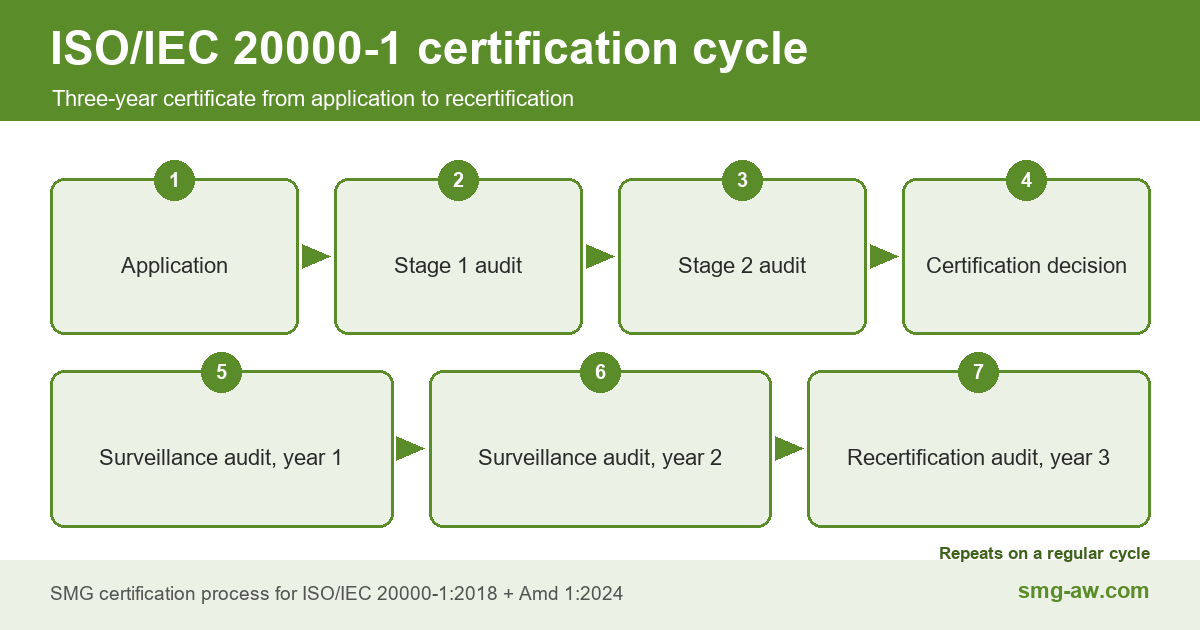
SMG certifies service management systems to ISO/IEC 20000-1:2018 + Amd 1:2024. We audit and certify.
- **Application:** you complete a short questionnaire so we can define the scope, sites and services and send a proposal.
- **Stage 1 audit:** we review your SMS design, documents and readiness, and confirm the plan for Stage 2.
- **Stage 2 audit:** we assess how the system works in practice, including your internal audit and management review.
- **Certification decision:** an independent SMG reviewer decides on the certificate, which is valid for three years.
- **Surveillance audits:** once a year in years one and two.
- **Recertification audit:** in year three, before the certificate expires.
If you hold an ISO/IEC 20000-1 certificate from another body, ask about transfer.
ISO/IEC 20000-1 vs ITIL vs ISO/IEC 27001
| Point | ISO/IEC 20000-1 | ITIL | ISO/IEC 27001 |
|---|---|---|---|
| What it is | Requirements for a service management system | Good practice framework | Requirements for an information security management system |
| Certifiable | Yes, the organization is certified | No, only people take ITIL exams | Yes, the organization is certified |
| Focus | Planning, delivering and improving services | How to run service practices | Protecting information |
| Combined audit with SMG | Yes, with ISO/IEC 27001 or ISO 22301 | Not applicable | Yes, with ISO/IEC 20000-1 |
Frequently asked questions
Which edition of ISO/IEC 20000-1 is current?
The current edition is ISO/IEC 20000-1:2018 with Amendment 1:2024. The amendment adds that you must decide whether climate change is a relevant issue for your service management system, and that interested parties may have climate-related requirements. No newer edition has been published, so certificates continue to be issued against the 2018 edition.
Is ISO/IEC 20000-1 only for IT companies?
No. Any organization that delivers services to internal or external customers can use ISO/IEC 20000-1 and certify to it. IT services are the most common case, but facilities management, business process outsourcing and shared service centers also certify. The audit looks at how you plan, deliver and improve the services in your scope.
What is the difference between ISO/IEC 20000-1 and ITIL?
ISO/IEC 20000-1 sets requirements that an organization can be certified against. ITIL is a set of good practices for running services, and only individuals take ITIL exams. The standard does not require ITIL. Many organizations use ITIL practices to meet ISO/IEC 20000-1, and the audit checks your system against the standard’s requirements.
How long does ISO/IEC 20000-1 certification take?
It depends on your scope, number of sites and services, and how ready your system is. Your service management system needs to have run long enough to show an internal audit and a management review before the Stage 2 audit. Many organizations plan several months from application to certificate. We confirm audit days in our quote.
Can we combine ISO/IEC 20000-1 with ISO/IEC 27001?
Yes. Both standards follow the same high-level structure, so SMG can run a combined audit that covers shared clauses such as context, leadership, internal audit and management review once. This saves audit time and keeps one set of records. Each standard still gets its own certificate and its own specific checks.
Can cloud service providers certify to ISO/IEC 20000-1?
Yes. The standard applies to any service model, including IaaS, PaaS and SaaS. The old cloud guidance, ISO/IEC TR 20000-9:2015, has been withdrawn, so the audit works directly from ISO/IEC 20000-1. Many cloud providers also use ISO/IEC 27017 guidance for cloud security controls inside an ISO/IEC 27001 system.
Related standards
- ISO/IEC 20000-2: guidance on how to apply each ISO/IEC 20000-1 requirement
- ISO/IEC 27001: information security certification for the services you run
- ISO 22301: business continuity certification that supports service continuity and availability
- ISO/IEC 27031: ICT readiness for business continuity
- ISO/IEC 27035 series: incident management practice that supports SMS incident processes