Last updated: 19 November 2026
SMG takes you from a PCI DSS v4.0.1 gap assessment to your Report on Compliance and Attestation of Compliance. PCI DSS v4.0.1 is the Payment Card Industry Data Security Standard published in June 2024 by the PCI Security Standards Council, the body founded by the major card brands. It sets security requirements for any organization that stores, processes or transmits payment card data, or can affect its security, including merchants, processors, gateways and hosting providers. All requirements that were future-dated in v4.0 became mandatory on 31 March 2025. PCI DSS is a compliance framework, not an ISO standard, so there is no ISO-style certificate. Compliance is validated each year through a self-assessment questionnaire or a Report on Compliance. SMG carries out PCI DSS v4.0.1 gap assessments, compliance audits against the requirements and readiness reviews before your Report on Compliance assessment, and trains IT, security and finance teams.
Key facts
- Standard
- PCI DSS Payment Card Industry Data Security Standard
- Current edition
- PCI DSS v4.0.1 (June 2024)
- Published by
- PCI Security Standards Council
- Type
- Industry compliance framework (scheme owned by PCI SSC)
- Who it is for
- Merchants, payment processors, gateways and service providers that handle or affect card data
- Certificate and audit cycle
- Annual validation by a Report on Compliance or a self-assessment questionnaire, each with an Attestation of Compliance
- Transition or revision status
- v4.0 retired end of 2024. Future-dated requirements mandatory since 31 March 2025. PCI SSC request for comments on v4.0.1 held June to July 2026.
- Related standards
- PCI SSF, PCI P2PE, ISO/IEC 27001, ISO/IEC 27005, SOC 2
- SMG service
- Gap assessment, compliance audit, Report on Compliance and Attestation of Compliance, SAQ support review, training
- Where SMG works
- North America: Canada, USA and Mexico. Middle East: Saudi Arabia, the GCC (UAE, Qatar, Kuwait, Bahrain, Oman), Lebanon and Türkiye. Europe: UK, Ireland, Belgium, Italy, Spain, Portugal, Austria and Switzerland. Africa: Egypt, Morocco, Tunisia, Algeria, Libya, Nigeria, Ghana, Côte d'Ivoire, Liberia, Congo (Kinshasa and Brazzaville), Kenya and South Africa. Asia: China, Japan, South Korea, Indonesia, Malaysia and Vietnam.
- Audit languages
- English, Spanish, French, Arabic, Mandarin, Cantonese, German and Italian. In other countries SMG works with qualified local auditors.
What is PCI DSS v4.0.1?
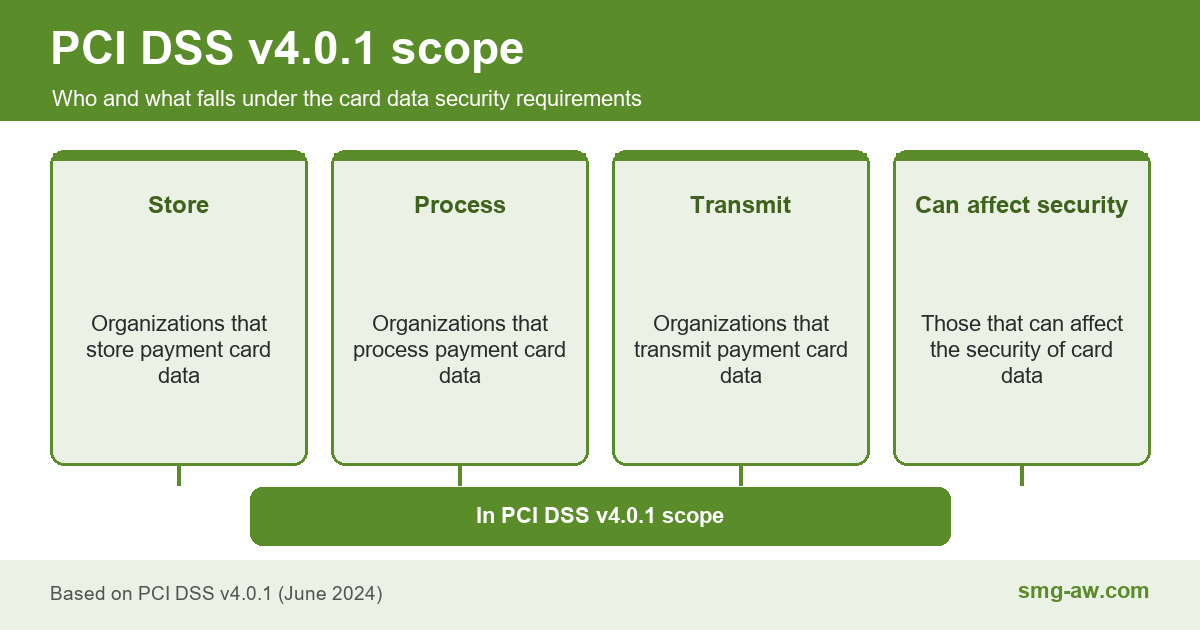
PCI DSS (Payment Card Industry Data Security Standard) is the set of security requirements for any organization that stores, processes or transmits payment card data, or that can affect its security. It is owned by the PCI Security Standards Council (PCI SSC), founded by the major card brands.
The current version is PCI DSS v4.0.1, published in June 2024. PCI DSS is an industry compliance framework, not an ISO standard, so there is no ISO-style certificate. Compliance is validated each year through a self-assessment questionnaire (SAQ) or a Report on Compliance (ROC), with an Attestation of Compliance (AOC).
Who needs PCI DSS compliance?
Any business that accepts or handles payment cards needs PCI DSS compliance, and so does any provider that can affect the security of card data. Your acquiring bank decides how you validate it.
- Merchants of all sizes, online and in store
- Payment processors, gateways and payment facilitators
- Hosting, cloud and managed IT providers in the card data environment
- Banks and fintechs in Saudi Arabia, Lebanon, the GCC and Canada
What are the benefits of a PCI DSS gap assessment and compliance audit?
An audit before your annual validation shows your gaps while you still have time to close them.
- A clear view of your cardholder data environment and what is in scope
- A requirement-by-requirement list of gaps against PCI DSS v4.0.1
- Fewer surprises during the Report on Compliance assessment or before you sign your SAQ
- Shared evidence with an ISO/IEC 27001 ISMS where controls overlap
How does PCI DSS compliance work with SMG?
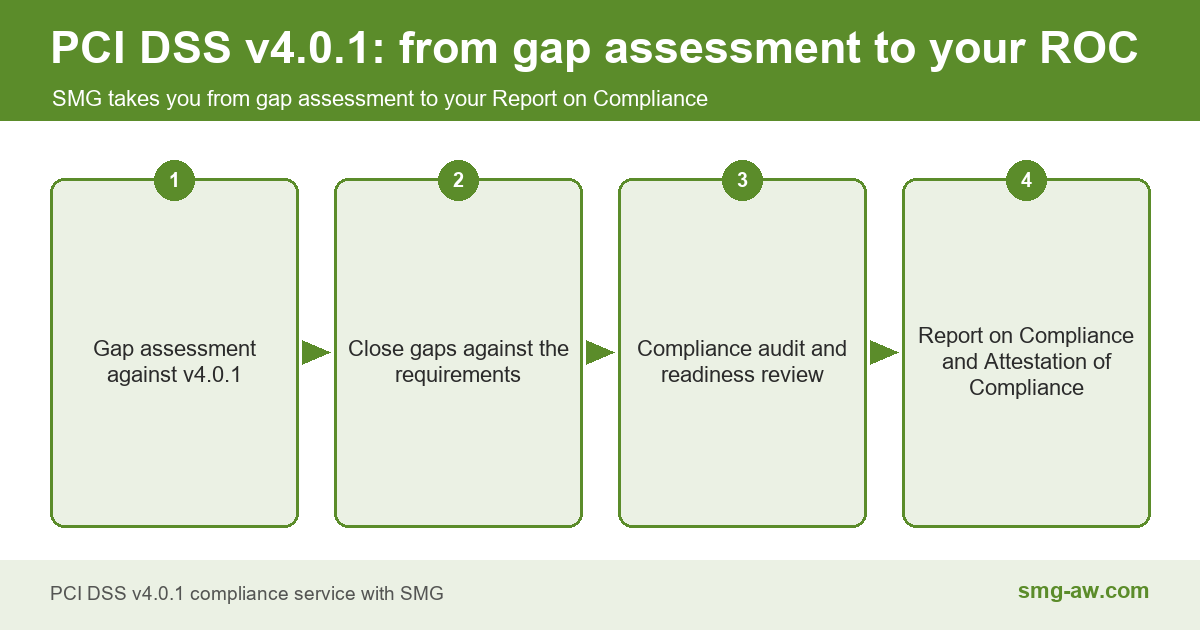
SMG takes you from a PCI DSS v4.0.1 gap assessment to your Report on Compliance and Attestation of Compliance:
- Scoping: we confirm your card data flows, sites, service providers and validation route.
- Gap assessment: we review documents and interview staff against the 12 principal requirements.
- Compliance audit: we sample evidence such as access reviews, logs and scan results, and test whether controls work.
- Audit report: findings by requirement, graded by risk.
- Readiness review: before the Report on Compliance assessment, we re-check open findings.
- Report on Compliance and AOC: once your findings are closed, you move on to your annual Report on Compliance assessment and Attestation of Compliance. If your bank accepts an SAQ, we review it with you before you sign.
- Training: PCI DSS v4.0.1 sessions for IT, security and finance teams.
What are PCI SSF and PCI P2PE?
PCI SSF and PCI P2PE are separate PCI SSC standards for payment software vendors and encryption solution providers.
- PCI Software Security Framework (SSF): the Secure Software and Secure Software Lifecycle (Secure SLC) Standards for vendors that build payment software. SSF replaced PA-DSS.
- PCI Point-to-Point Encryption (P2PE): requirements for solutions that encrypt card data from the payment terminal to the provider’s decryption environment. Using a listed P2PE solution can reduce a merchant’s PCI DSS scope.
SMG offers gap assessments and training against SSF and P2PE.
How does PCI DSS connect to ISO/IEC 27001 and SOC 2?
PCI DSS shares many controls with ISO/IEC 27001 and SOC 2, such as access control, logging and incident response, but holding one does not prove the others.
ISO/IEC 27005 supports the targeted risk analyses that PCI DSS v4.0.1 asks for, and the ISO/IEC 27036 series helps you manage the service providers in your card data flow.
SAQ or Report on Compliance: your route with SMG
| Point | Self-assessment questionnaire (SAQ) | Report on Compliance (ROC) |
|---|---|---|
| Who chooses the route | Your acquiring bank | Your acquiring bank |
| Output | SAQ and Attestation of Compliance | Report on Compliance and Attestation of Compliance |
| Timing | Annual validation | Annual validation |
| Route with SMG | Gap assessment, compliance audit, then an SAQ review before you sign | Gap assessment, compliance audit and readiness review, then your Report on Compliance and AOC |
Frequently asked questions
Can SMG take me through to a PCI DSS Report on Compliance?
Yes. SMG takes you from a PCI DSS v4.0.1 gap assessment to your Report on Compliance and Attestation of Compliance. We scope your card data environment, audit your controls against the requirements, re-check open findings and train your teams. If your bank accepts a self-assessment questionnaire instead, we review it with you before you sign.
Which version of PCI DSS applies now?
PCI DSS v4.0.1, published in June 2024, is the current version. It clarifies v4.0 without adding requirements. The future-dated requirements became mandatory on 31 March 2025. PCI SSC ran a request for comments on v4.0.1 in mid-2026, so check for a newer version before your next assessment.
Is PCI DSS mandatory?
PCI DSS is not a law in most countries, but it is a contractual requirement. Card brands require it through acquiring banks, and acquirers pass it on to merchants and service providers in their agreements. Failing to comply can lead to fines from the acquirer, higher fees or losing the ability to accept cards.
How long does a PCI DSS gap assessment take and what does the cost depend on?
Both depend on the size of your cardholder data environment, the number of sites and service providers, your validation route and travel. A small merchant using a hosted payment page needs far less time than a multi-site service provider. SMG confirms the days and price in a written quote after scoping.
Does ISO/IEC 27001 certification make me PCI DSS compliant?
No. The two overlap in access control, logging and incident response, but PCI DSS has prescriptive requirements for cardholder data that must be validated on their own. ISO/IEC 27001 evidence can still be reused in a PCI DSS assessment, which saves time.
Related pages
- ISO/IEC 27001 certification: ISMS certification that shares many controls with PCI DSS
- SOC 2 readiness assessment: another assurance route customers ask service providers for
- ISO/IEC 27005: risk method that supports the targeted risk analyses in PCI DSS
- ISO/IEC 27036 series: managing the service providers in your card data flow